A common thread between all of my favorite shows is the impact of our choices. The traps we lay for ourselves. The paths in life that we go down. The things we cannot redo, cannot re-learn, cannot replace. The paths you cannot return down.
Mike Ehrmantraut rues his past as a dirty cop. He knows he can never overcome his past mistakes, the loss he caused. He comes to terms with it in a succinct: “We all make our choices.”
Jimmy McGill asks about a time machine – what would you go back and change if you could? Walt, in possibly his crankiest form, reminds him “You are not talking about a time machine, you are talking about regrets.”
Chuck, in what may be a cry for connection to Jimmy, or a reflection on his own failures in relationships emphasizes that “If you don’t like where you’re going, there’s no shame in changing our paths.”
Avon Barksdale, holding court over his incapacitated brother, muses on the ramifications of one moment in our lives: “See, the thing is, you only got to fuck up once. Be a little slow, be a little late. And how you ain’t never gonna be slow? Never be late?… it’s life.”
Regrets. Pride. Control. These men connect across a theme. We are creatures of our own choices, not circumstance, not luck. Our choices, our pride, our decisions, are all linked and we will never understand those linkages as best as we try. We think we understand these things, that we can control and change our timeline, our past. That we know our set paths. But life humbles you. Your choices humble you.
You pay for your pride. You pay for your inability to be open with yourself and others. You pay for the fear of choosing another path and what is beyond it. Avon, Jimmy, Walt, Mike – all prisoners of their choices and their pride. All bound by decisions and pathways they cannot return to, cannot make up for. Just like all of us.
Boredom and a little bit of loneliness will drive a man to do certain insane things, sometimes embarrassing things. In my case, these things are not entirely embarrassing, more so just inconvenient and expensive side quests.
As was the case on July 24th, 2026. Having been sniped by an Instagram ad for a showing of Ross McElwee’s Sherman’s March at Film Forum theatre in New York City, looped a trip into the city with a pre-existing Facebook Marketplace pickup. Maybe the algorithm latched on to my road trip fueled re-dedication to Ken Burn’s The Civil War, or maybe YouTube shared that fact that I had watched all of Shelby Foote’s raw interview footage while driving across the nation with Meta’s data crushers. Regardless, it worked. I went.
The film ostensibly began as a documentary to trace the lingering effects of Sherman’s march through the South in 1864 and 1865. It actually turned into a cinema verite of McElwee confronting his own loneliness in life during his own tour through the South of the 1980s. He films various women that he seeks to wed or live with or use to make something out of himself, his documentary, and perhaps please his family. I am still not sure what to make of it entirely, and maybe he did not either.
“William Faulkner, in Intruder in the Dust, says that for every Southern boy, it’s always in his reach to imagine it being 1:00 on an early July day in 1863. The guns are laid. The troops are lined up. The flags are already out of their cases and ready to be unfurled. But it hasn’t happened yet. And he can go back to the time before the war was going to be lost. And he can always have that moment for himself.” – Shelby Foote
I like to imagine that when McElwee originally set out to trace Sherman’s March he thought he would find the scene Faulkner describes, of a South in which every man, woman, boy, and girl imagine that they too can go back to the high water mark of the Confederacy. That the wrongs thrust upon them by the Federals could be righted with the right narrative and just enough embellishment. That he would find a South still suspicious of red haired gentlemen, one that still speaks of Sherman’s neckties, and wonders aloud at what it was like before his Army came though.
What followed was not this. What I saw in that dark New York theatre was McElwee assuming Sherman’s March as allegory for his point in life at the time. That he, aloof in life and unsure of what to do next with himself, waged a total war on himself, on the women he met, on his dignity, while tearing through the south.
The item that sticks with me most from this movie is really how comfortable people are in front of McElwee’s hulking camera. It helps to capture the time remarkably well, or, as I did not live through this time, what I imagine is an accurate depiction of the times.
It’s the late 1980s. Home videos and such are just starting to become a thing, recording technology is becoming accessible for many people but not all people. Everyone, even though they are speaking to McElwee through his huge shoulder mounted camera, is relatively at ease and seems themselves in front of the lens. There’s an inherent trust even in these recorded interactions that you don’t see today. In modern candid clips, similar to McElwee’s type of filming, I feel like there’s a general unease or lack of authenticity in the clips. Hell, the closest thing I could think of would be people’s old Snapchat memories. I suppose it’s because the ubiquity of cameras now and the knowledge that the material generated at the other end of that lens can go anywhere. Maybe I’m just imagining things.
Anyways, should’ve finished this post earlier but now I’ve sat on it for a month and forgot what I had to say.
The World Cup Final started at 3:00 eastern time on Jul 19th, 2026. Argentina and Spain met each other in New Jersey, the closing match to a long and popular American World Cup.
But if you arrived at Pizzeria Da Vinci in Deep River, Connecticut, you would not know. The pinnacle of The Beautiful Game, any of trace of it, was nowhere to be found.
On the back wall, an 85-inch screen plays a mid-day Red Sox-Rays game to an empty dining room. They’re at Fenway. 6-1 Sox. Top of the 8th.
The bell at the door rings. “Is Johnny heah??” drawls an unseen New Englander.
“No, he’s off today”
“Oh…”
A pair of kids, one sporting a Pizzeria Da Vinci shirt, amble in behind the Regular and park themselves at the low four-top in front of the screen, cups of ice cream in each hand. Perhaps they are employees. Perhaps not. They alternate between a disinterested glance at the Sox television and scrolling on their respective phones.
“It’s 0-0 in the soccer game” one mumbles. They briefly shuffle and exit again, now with twenty dollars cash in the Pizzeria kid’s hands.
In the front corner of the restaurant, a small 18″ screen plays silent Bob Ross re-runs to myself and the Regular.
It’s after dark on July 4th, 2026, somewhere on the outskirts of Lansing, Michigan. It’s my seventh day of driving across the country.
For the United States’ 250th birthday, residents of South Lansing transformed their surrounding sprawl into launchpads for rockets, fountains, mortars, and missiles of all variety. The Super Inn parking lot, the KFC drive-through entry and a nearby Ford dealership have all been turned into well-armed batteries with a limitless supply of projectiles. Sparking red, white, blue, green bursts just barely crest the trees and chain marquees that surround my position. Veterans of Verdun, Cemetery Ridge, Baghdad, or Monte Cassino would likely weep at the uninterrupted and ceaseless reports of shells and shot detonating in the night.
And it was likely the same scene across the entire country. I knew that my departure city, Long Beach, was likely enveloped in a haze of sulfurous smoke and noise. And it would be the same in Tonopah, Nevada, and in Rapid City, South Dakota, and Madison Wisconsin, and all along I-80 in West Virginia, and the same in my destination in New Haven. What a place. What a country. I sat in the parking lot for an hour just to take it all in, to watch and hear the shells burst over refined capitalism, to make my own memory of America at 250 and mull what it means to me.
Driving across the American landscape for seven consecutive days naturally begs a man to consider not only the land you hurtle through but the people, the nation, the state, that us Americans are a part of. What is America? What do we make of it? What do we make of it at 250 years? Of course, “seeing America by travelling it” is an extensive literary tradition, and these questions have already been tackled by minds far more qualified and equipped to answer them than my own. Tocqueville, Steinbeck, McMurtry, Kerouac, even the leading policy mind in China’s politburo have all sought to discover America through travels on the road, through seeing and feeling and finding whatever they see in this country. But none of them have asked these questions from a Wendy’s parking lot in Lansing.
America is the most significant and consequential group project in history. It is whatever Americans agree, or are manipulated, to see. America and whatever someone thinks America is, is paradoxically an extremely individual opinion that makes a part of a whole. So what do I see?
I see, like Huning and Steinbeck, crushing hypocrisy and potential, with hypocrisy being maybe the defining trait of the American nation. I see such immense natural beauty and absolutely depraved manufactured landscapes. Such innovation and brutally regressive thought. It is a place determined to write its history and make and remake itself through focusing on the efforts of individuals but completely and consciously ignorant of Americans, the people, that make the nation what it is and was.
Maybe, at 250, the political climate colors my view. Maybe I’m just in a mood.
And that paragraph above is why people like myself don’t answer those questions. Maybe I’ll come back and screw with it later.
June 11th, 2026 (important detail): I texted Javi as I began boarding my flight to “San Salvador” International Airport from Atlanta’s austere Terminal F.
“??” was the reply. His gig down there was July 8th to 13th not June. I insist that I’m innocent.
In a panic, I booked a “Surf Villa” in nearby La Libertad during the taxi and off we went. Too much effort to change any flights and not take the trip. Pretty much everything that follows is a dumping ground for my thoughts on the past two days…
Transportation
South America is largely moved by the deep and throaty lope of heavy diesel engines, just as much of Europe trundles along to the rhythmic clicking of TDI valves. The highways or major roads are totally enveloped by the unmistakable roar and signature black clouds of smoke as buses lumber away from totally unmarked but locally known stops.
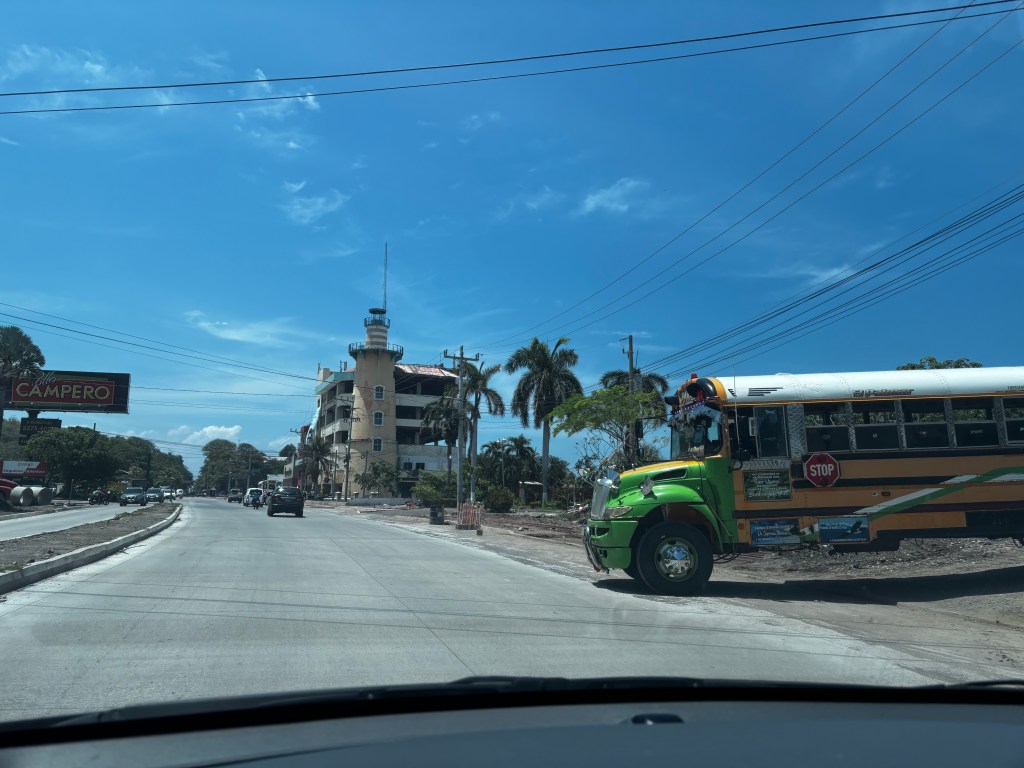
El Salvador is another entry into the book of Absolutely Fascinating and Terrifying South American Bus Systems. The busses here are predominantly imported American school bus models that we all know, mostly the 40+ seat Trane or Bluebird models. I swore I saw one with the vague remnants of “New Britain Sch-” on its side. They are brightly decorated with green, blue, purple, or reddish-orange hues, though some maintain their stock yellow, with each color scheme ostensibly identifying a route. But there was no obvious standardization or governing body. Some sport fiberglass wings at the rear, some wear chrome. All have an interesting squat at the rear end, perhaps intentional, or a sign of well-worn leaf springs. While much larger than their Chilean equivalents, these landships are driven with the exact same fervor, although they are evidently limited in their traffic-cutting abilities by their sheer size and weight. My favorite was the 102 bus from La Libertad to San Salvador (I think) in a nice deep green, white and yellow-sh scheme. Fifty-nine cent fare.
oops probably the best pic I got. not the 102. Maybe 187.
San Salvador
I needed to see the big city. The library in San Salvador was explicitly mentioned by the rental car counter folks as something to see and do in the city, so I went there first after parking.
It is an interesting study in dueling hegemons or perhaps a case study of where Latin America finds itself in the global order. It is a very new building, opened in 2023 with striking architecture that sets it apart from literally everything else in the country. It is immediately adjacent to the national palace, on the site of the former national library. It is evident that great effort has recently turned the area in front of it into a large pedestrian plaza, something akin to a national gathering place. It would not be out of place in the urban centers of Shanghai or Shenzhen.
Most interestingly, the library proudly sports, over its entire edifice, a red badge proclaiming: “ASISTENCIA DE CHINA: PARA UN FUTURO COMPARTDIO.” This is about as subtle as a wrought iron gardening tool swung against the side of your head. China devoted $54 million dollars through its aid group towards building this highly modern, 24/7 library. Yet, the library itself is filled to the brim with curious displays of American culture. Star Wars, Game of Thrones, Lord of the Rings, and various superheroes fill the lobby and aisles. American computers are draped on nearly every floor. Just outside the library, you will find a Marriot, a Pizza Hut, a Burger King. And in each of these establishments, American dollars pass over the counters.
The Market
As soon as I set foot into the open air market, set just off the main market building itself, a chorus of “Una dollar, una dollar!” welled up, overtook the square, and did not stop until I left. I hadn’t meant to end up here, but I was glad I did. It feels super lame to type this out but the sheer variety and density of noise, the busyness of the square itself, the variety of goods offered, it was like something and somewhere I’d never been before. And it was not for show. People did their daily shopping here and made a living, or tried to. A complete sensory overload. But there’s no way everything was a dollar.
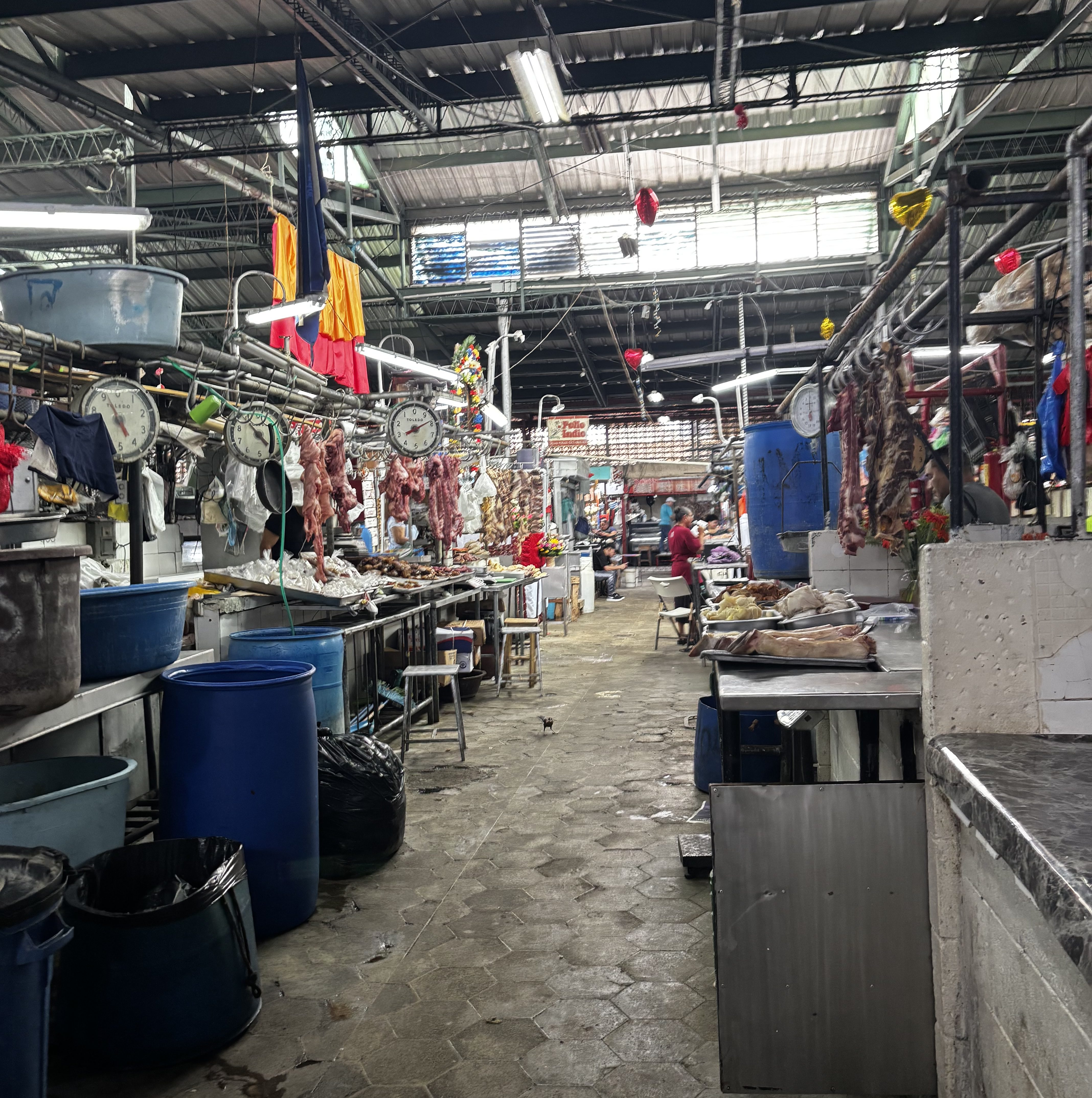
View into the meat section of the market. Hordes of women were stuffing small sausage casings and tying them off all in one fluid motion. I wanted to just stop and watch but it felt weird honestly.
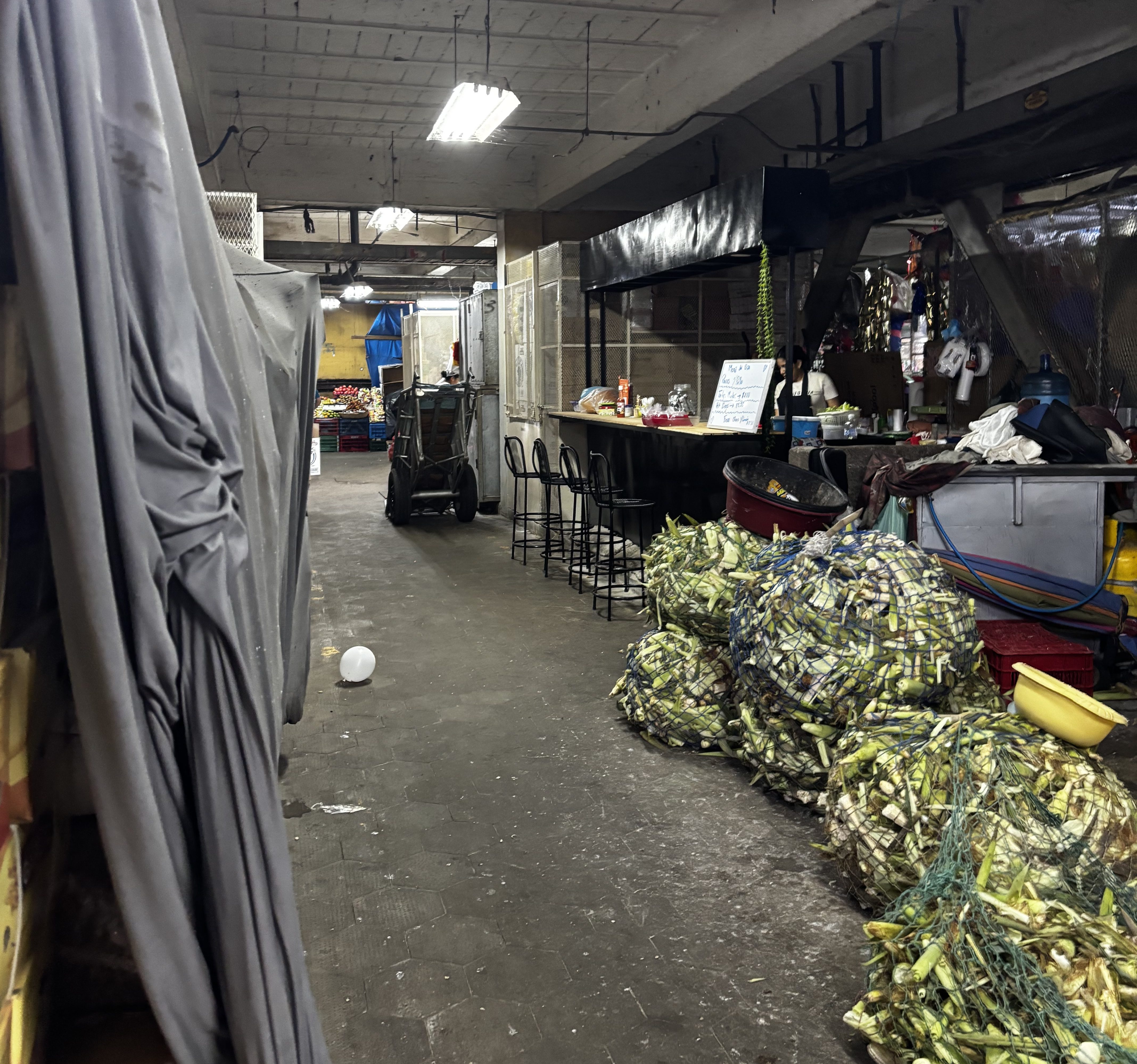
I dipped back into the main market, which was an absolute labyrinthian system that I can only assume was split into an upper and lower level. Organization by type of good was evident but I completely failed to grasp how it was all arranged. Live animals, produce, meats, household goods, food, beer, religion, music; all of it was here and all of it for sale. I was completely overwhelmed and, exasperated, settled on the first place with a menu so I knew what I was getting and how much it cost. It was a nameless stall deep in the basement of the market run by a mother and daughter duo, next to the largest pile of garlic I’d ever seen and kids husking sweet corn while ripping TikTok dances. Globalization.
I fumble-fucked my way through a horrendous conversation (Pollo? I pointed at the stove desperately hoping for the chicken soup… oh she’s saying something… not ready for… thirteen? minutes? fuck. Torta Mixta. crap I don’t know what she’s asking. Si. whatever, this will be good.) Ended up with some sort of sandwhich, which was good, comprised of gamey beef, hot dog, lettuce, tomato. And aguas frescas. $2.30. I also got some sort of sopa de pollo from a vendor promising it for just “una dollar” but paid $7 and it honestly wasn’t much to write home about.
Lunch spot. Deep in the basement
Back at the Beach
Retreated to my Surf Villa after the day in San Salvador. I ended the day up in San Salvador in one of the richer neighborhoods up the mountain (New Jerusalem?) and had some bomb ass coffee.
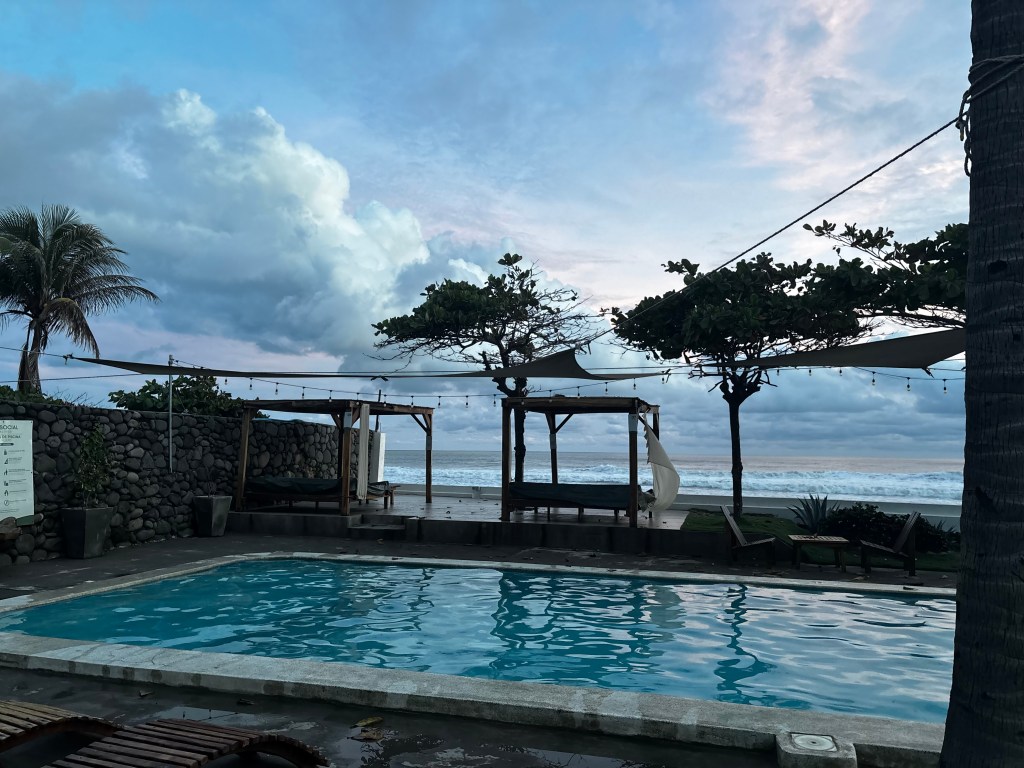
Ended the day at a “beach bar” which I think is genuinely just someone’s home that’s conveniently adjacent to the Villas, and had four beers for $6. I watched the waves crash up on the scraggly stone beach and generally had a blast just chilling there. What a time. Ace Pilsner. La cerveza de El Salvador.
Got some pupusas at the place down the street for, of course, a dollar each, and that was my night. Kinda sick.
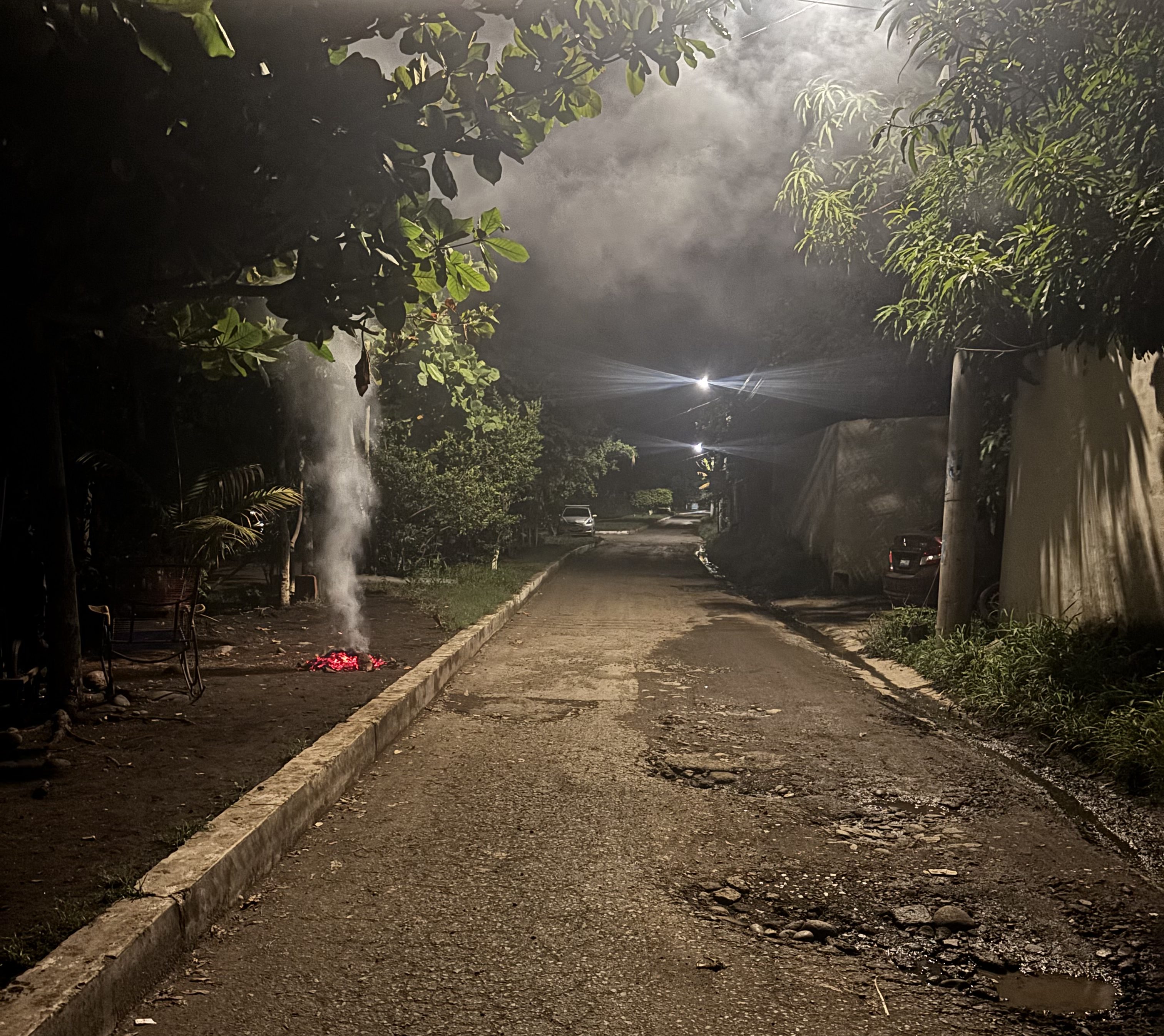
Coconut husks burn in a pile after the day’s end. Pretty certain the coals from these would become the basis of the next day’s cooking fire.
Anyways, check your dates before you schedule these things.
Bill is typing. Typing. Typing. Typing. Is this a text block? What is this? How do I do this nonsense?
HEADING TEST HEADING TEST
Now this part is fun. Main page not so fun
Testing Testing Testing
Testing the ANNOTATION feature
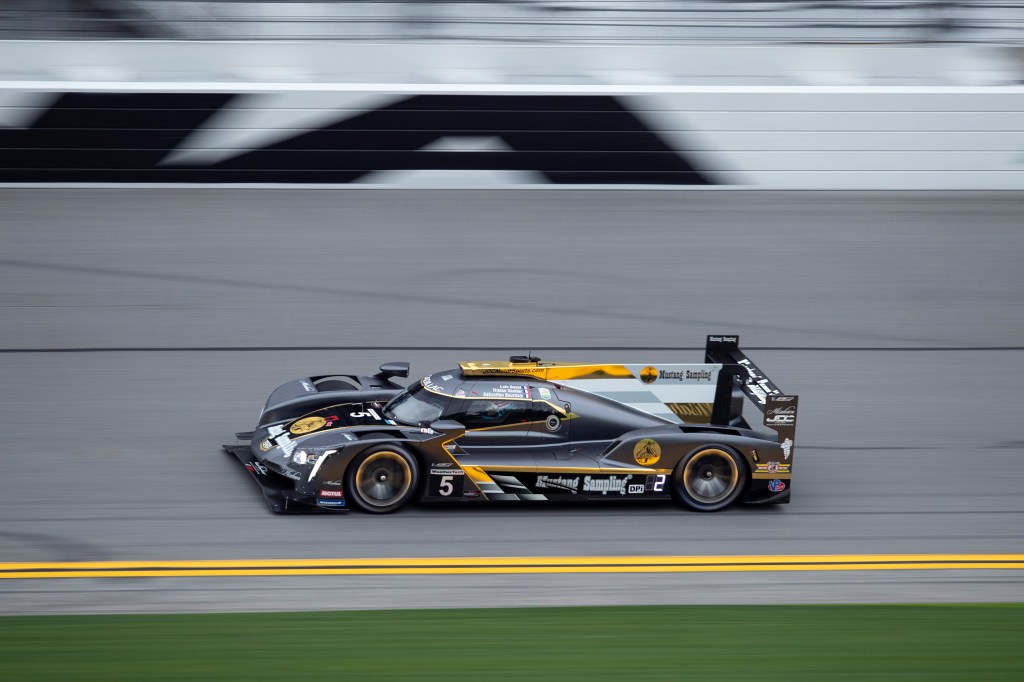
Cadillac Racing; Daytona Roar; Daytona International Speedway in Daytona Beach, Florida; January 22-24, 2021; Cadillac Dpi-V.R teams AXR Whelen Engineering (#31), AXR Ally (#48), JDC Motorsports (#5), and Chip Ganassi Racing (#01); (Richard Prince/Cadillac Photo). Nice OK so I got photos more or less figured out.