Twelve Hours Around Mount Panorama
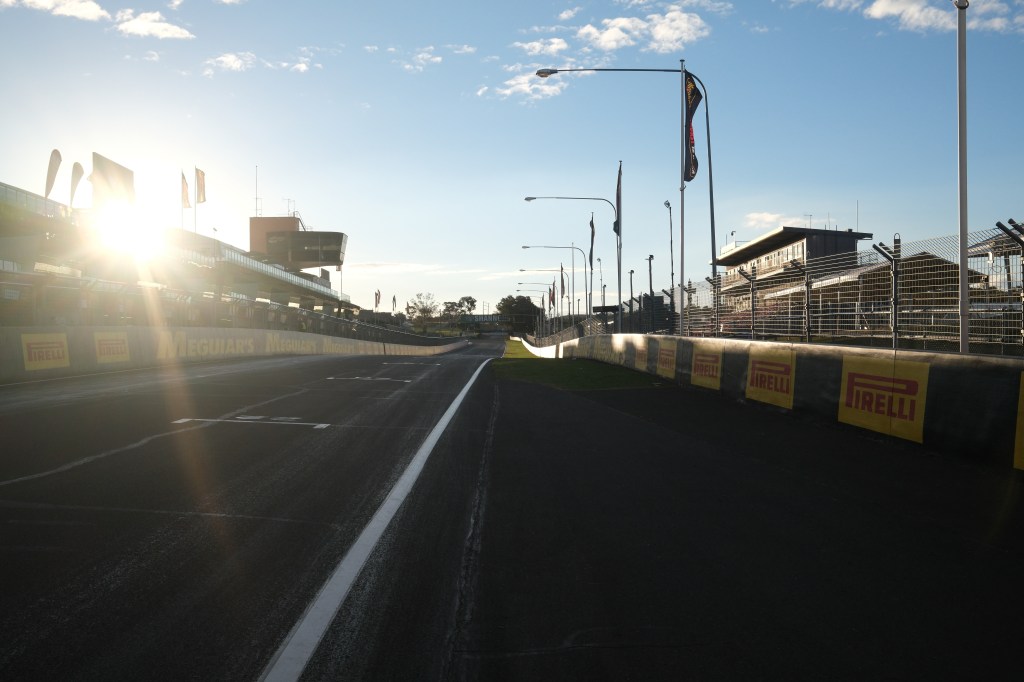
Having been to a fair few of these sports car races I believe I am equipped to make the following claims. No other sports car race on earth provides the sheer entertainment, spectator value, or intrigue as the annual Bathurst 12 Hour.
It pits a huge variety of manufacturers and car types against each other on one of the greatest and most challenging courses in the world. It attracts stars from around the motorsport world. You get great value for the the ticket. It pits Australia’s best against the world, including wildlife. You never know what will happen. It is one of a kind.
The 12 Hour is an exceptionally young event compared to the other greats in this field of motor racing. Sebring, Daytona, Road Atlanta, the Spa and Nürburgring 24 Hours, and of course, Le Mans, all boast long tenures and rich histories of anywhere from 30 to 100 years of running. The Bathurst 12 Hour only began in 1991 as a humble production car race. Its first run only lasted a short four years before being revived in 2007, and it gained new life yet again in 2011 with the admission of the popular GT3 cars to the field that, by and large, replaced most of the production vehicles.
What the race may lack in a long and fabled heritage is easily compensated by the sheer wonder of the track it is held on, the unique entries, and the incredible moments it delivers year after year.
From 2015 onwards the race benefitted greatly from new ownership in the hands of the Supercars ownership team, the introduction of the Intercontinental GT Cup and its subsequent inclusion in that Cup, the use of streaming services such as YouTube to deliver the race, and a hot streak of simply fantastic races.
Despite its short history, the race has quickly built a heritage of its own. From 2014 onwards, viewers were treated to a string of great events. Katsumasa Chiyo’s legendary charge up the mountain for Nissan in 2015. Van Gisbergen, Parente and McLaren’s record-breaking heroics in 2016. Ferrari’s iconic win in 2017 at the hands of Supercars aces Lowndes and Whincup. Audi’s triumph in 2018. Matt Campbell’s legendary last gasp lunge for the win in 2019. The thundering Bentleys running amok over the mountain for five years and finally winning in 2020.
Often, if these races did not deliver in the quality of racing, they certainly delivered in chaos. The sheer challenge of the mountain and the deviation in… quality and type of entries more often than not leads to a string of huge and bizarre incidents that variably involve poor decisions, hard racing, big shunts, and yes, even wildlife.
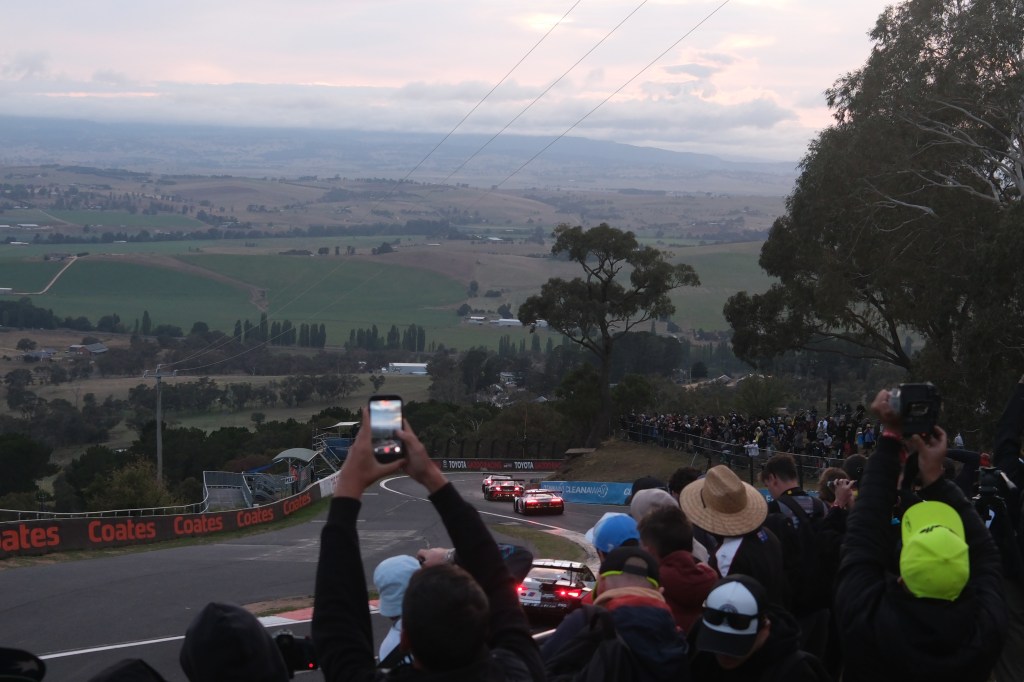
Like many things, COVID-19 almost killed the damn thing. 2021 was cancelled and 2022 and 2023 drudged along with a reduced entry list compared to prior editions. The international interest and intrigue had mostly waned, but the Australian outfits and oddball production car entries kept the flame lit, just as they had prior to the race’s growth in international stature. Only now, in 2026, do I feel the race has returned to the point it was before COVID, and this was easily demonstrated by the record 55,000+ attendance on Sunday.
It is a fantastic race. From starting in the dark to racing to the late afternoon, the setting could not be more suited to an epic sportscar race. The Mountain is the ultimate arena for these kinds of cars, a combination of elements that is described by drivers as part Nordschleife, part Macau or Monaco, and part Road Atlanta. The level of challenge it poses for drivers is only equaled by the level of beauty it provides for spectators.
The top of the Mountain is THE place to be, a place where you can get amazingly close to these cars threading the needle through the concrete canyons and Australian landscape. They always blow by with such incomprehensible speed while the elevation changes and bumps try their best to unseat the car. The cars spark and groan under the lateral loads and look completely on edge. They whistle as they approach and thunder away from you. And all of this is framed by the Australian countryside and the rolling valleys of Bathurst approximately 600 feet below your position. There is no track better, on the entire planet, to watch these machines from. Bathurst is it as far as I am concerned.
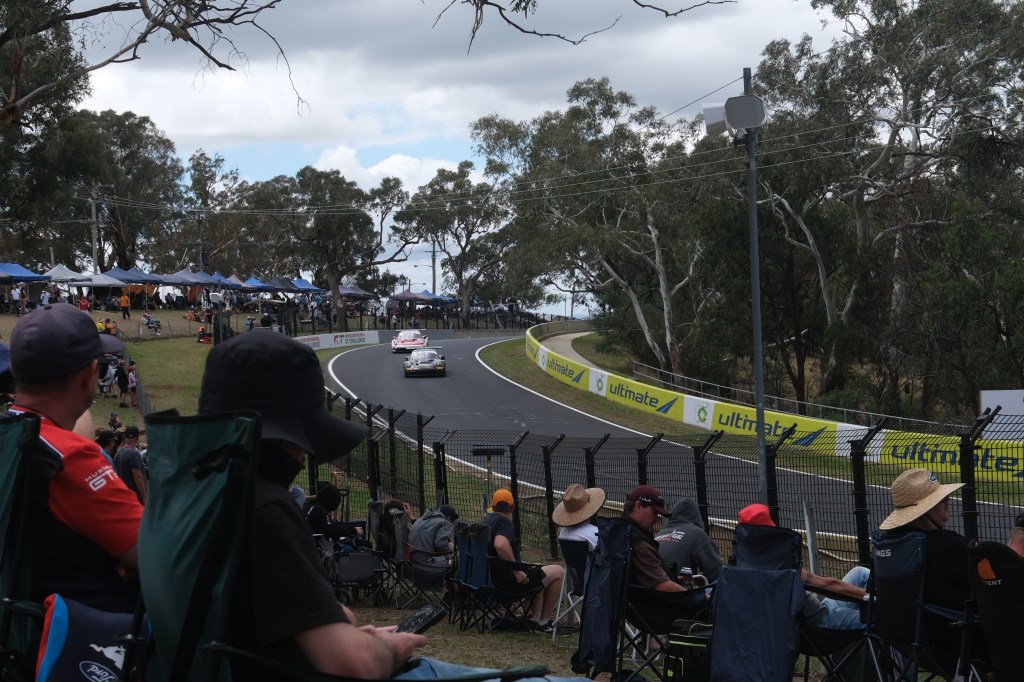
The Race
This year delivered. Under the cover of darkness, maybe less than 15 minutes into the race, the Ford Mustang of Chris Mies turned a Kangaroo into many smaller pieces of a Kangaroo with his splitter and windshield. We were blessed with a spectacular sunset.
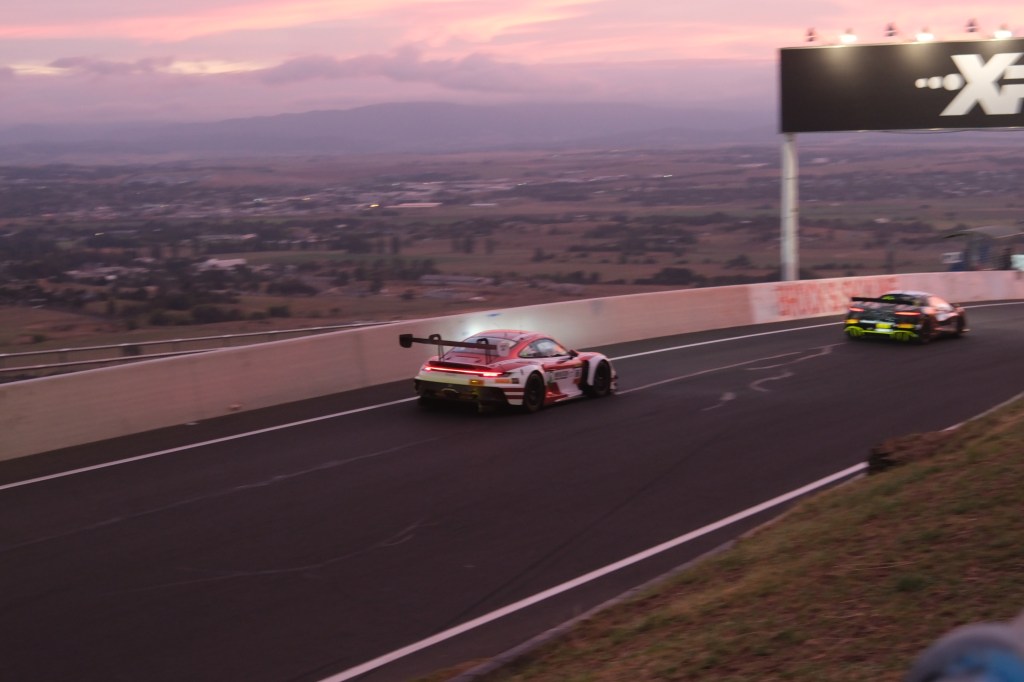
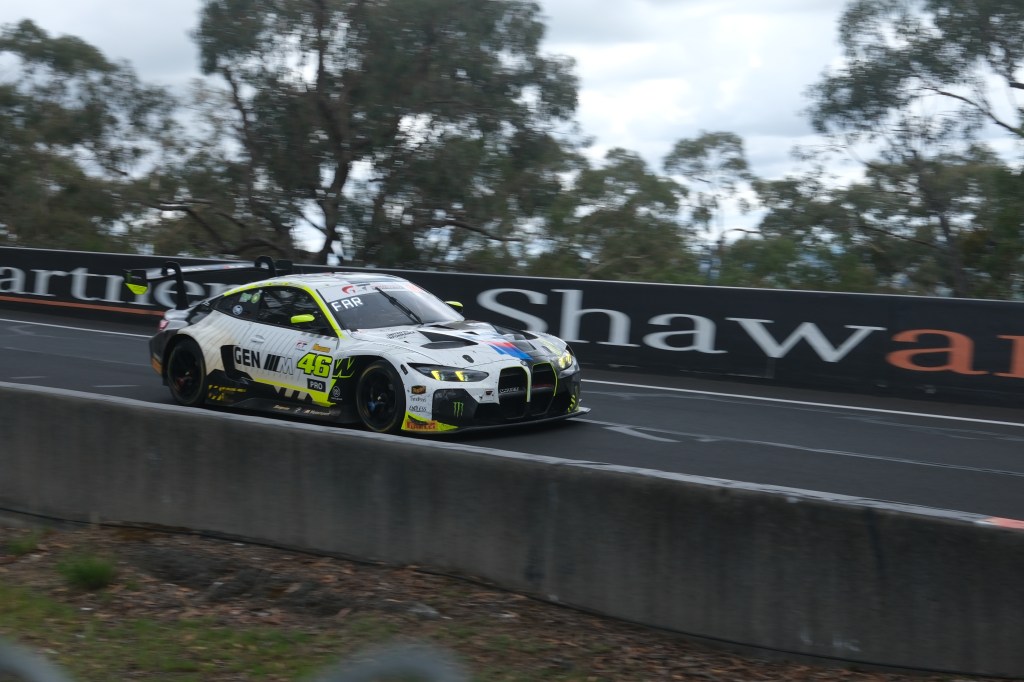
After the sun rose, it was a relatively un-eventful first third of the race; the WRT #46 entry (co-driven by THE Valentino Rossi) and the #32 entry comfortably led and swapped positions during pit cycles, with a few Mercedes chasing them all the while. Most notable was the #77 entry from Craft Bamboo, which sported an Initial D livery, and the two-time winner, Kenny Habul’s #75 AMG-Mercedes entry. The locally popular #222 from Scott Taylor Motorspot, an all-aussie outfit, kept within reach as did the tired old warhorse of Jamec’s Audi R8.
Around halfway, the fatigue of navigating the mountain began to set in on the drivers. Incidents began to take their toll on the field, including one I saw with my own eyes: The QUADRUPLE-penalized, moving chicane that was the sole McLaren 720S in the race eased itself into the barriers at about hour 5. The #32 fell back a ways after some damage at about this point too. My dad and I feasted on pies and fries from the stand at the Bend which benefitted the local soccer club. In my opinion, these are only concessions worth any time at the track.
The race was completely flipped on its head when Paul Aron, finding himself in the lead for Craft Bamboo after a yellow for a reason I cannot recall and sloppy driving from the #46, plowed into a spun car at the base of the mountain due to various holes in marshalling and communications. It completely obliterated the car and will certainly go down as one of the largest incidents in Bathurst 12 Hour history. We were standing there just thirty minutes earlier. I walked down to take in the carnage, and what a sight it was. Immediate red flag.
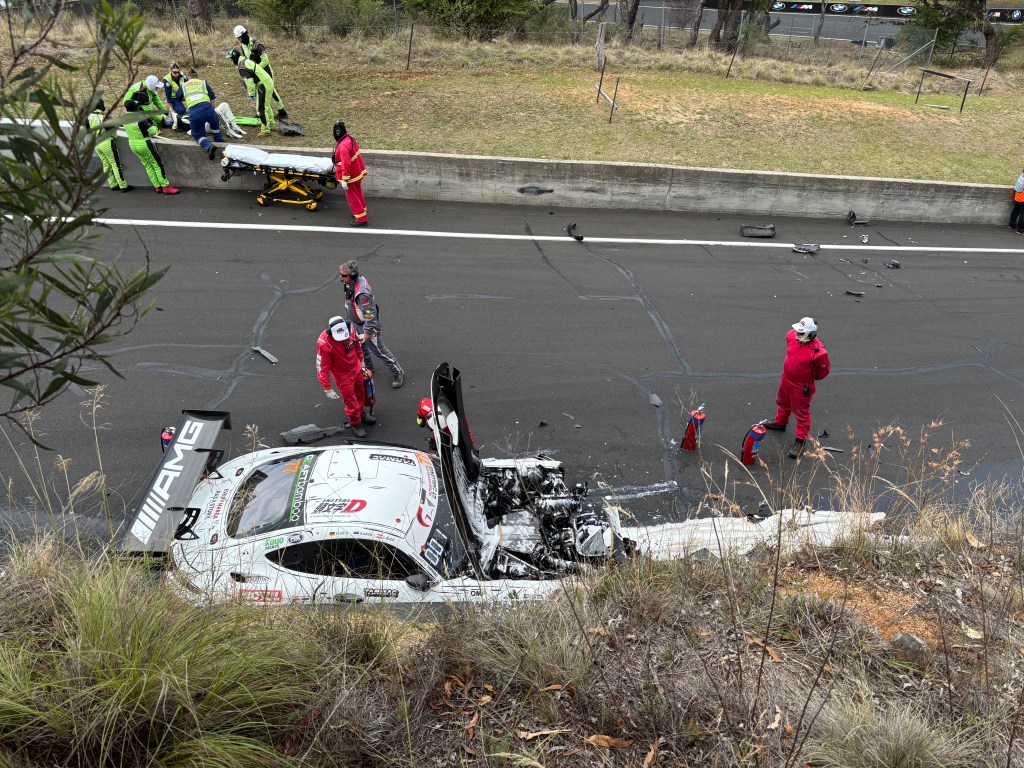
The #75 now looked to be set for its third victory in four years, having inherited the lead. The #888, having come from 29th on the grid also appeared in 2nd after the red flag. But then came the chaos. First, the #2 Corvette, having shown surprising pace all day, lost its bid for a win at the base of the Esses due to suspension failure. It appeared now that the #75 and #888 could just cruise to a 1-2 for Mercedes. But it was not to be.
A pair of Aussie-fielded Mercedes got together coming up the mountain, in a display that sort of indicates the Supercars guy’s apparent inability to follow through on longer stints, and brought out a yellow. While the rest of the field pitted, the #32, having crawled back from its wildlife-induced damage, sat in the lead on the final restart. And then quickly squandered this by throwing the sloppiest block into T1 on the restart and getting plowed by the #75. We had migrated down to T1 specifically for this restart and it ended up being the deciding moment in the race. The #888, #46, and the sneaky Pro-Am Porsche 911 (#86) snuck through and finished in that order.
Post Race
After the race we got to run straight to the podium. Saw Vale46 in the flesh. Observed the teams packing up. Went for a run of the course. And found Kangaroo bits on the backstretch. The area still reeked of livestock, animal, and motor oil. I picked up a small piece of Ford-blue carbon, splattered with Kangaroo blood. I will leave the pictures out of this one.
What a place. What a race. I will return.
 Bill Blog