A common thread between all of my favorite shows is the impact of our choices. The traps we lay for ourselves. The paths in life that we go down. The things we cannot redo, cannot re-learn, cannot replace. The paths you cannot return down.
Mike Ehrmantraut rues his past as a dirty cop. He knows he can never overcome his past mistakes, the loss he caused. He comes to terms with it in a succinct: “We all make our choices.”
Jimmy McGill asks about a time machine – what would you go back and change if you could? Walt, in possibly his crankiest form, reminds him “You are not talking about a time machine, you are talking about regrets.”
Chuck, in what may be a cry for connection to Jimmy, or a reflection on his own failures in relationships emphasizes that “If you don’t like where you’re going, there’s no shame in changing our paths.”
Avon Barksdale, holding court over his incapacitated brother, muses on the ramifications of one moment in our lives: “See, the thing is, you only got to fuck up once. Be a little slow, be a little late. And how you ain’t never gonna be slow? Never be late?… it’s life.”
Regrets. Pride. Control. These men connect across a theme. We are creatures of our own choices, not circumstance, not luck. Our choices, our pride, our decisions, are all linked and we will never understand those linkages as best as we try. We think we understand these things, that we can control and change our timeline, our past. That we know our set paths. But life humbles you. Your choices humble you.
You pay for your pride. You pay for your inability to be open with yourself and others. You pay for the fear of choosing another path and what is beyond it. Avon, Jimmy, Walt, Mike – all prisoners of their choices and their pride. All bound by decisions and pathways they cannot return to, cannot make up for. Just like all of us.
Boredom and a little bit of loneliness will drive a man to do certain insane things, sometimes embarrassing things. In my case, these things are not entirely embarrassing, more so just inconvenient and expensive side quests.
As was the case on July 24th, 2026. Having been sniped by an Instagram ad for a showing of Ross McElwee’s Sherman’s March at Film Forum theatre in New York City, looped a trip into the city with a pre-existing Facebook Marketplace pickup. Maybe the algorithm latched on to my road trip fueled re-dedication to Ken Burn’s The Civil War, or maybe YouTube shared that fact that I had watched all of Shelby Foote’s raw interview footage while driving across the nation with Meta’s data crushers. Regardless, it worked. I went.
The film ostensibly began as a documentary to trace the lingering effects of Sherman’s march through the South in 1864 and 1865. It actually turned into a cinema verite of McElwee confronting his own loneliness in life during his own tour through the South of the 1980s. He films various women that he seeks to wed or live with or use to make something out of himself, his documentary, and perhaps please his family. I am still not sure what to make of it entirely, and maybe he did not either.
“William Faulkner, in Intruder in the Dust, says that for every Southern boy, it’s always in his reach to imagine it being 1:00 on an early July day in 1863. The guns are laid. The troops are lined up. The flags are already out of their cases and ready to be unfurled. But it hasn’t happened yet. And he can go back to the time before the war was going to be lost. And he can always have that moment for himself.” – Shelby Foote
I like to imagine that when McElwee originally set out to trace Sherman’s March he thought he would find the scene Faulkner describes, of a South in which every man, woman, boy, and girl imagine that they too can go back to the high water mark of the Confederacy. That the wrongs thrust upon them by the Federals could be righted with the right narrative and just enough embellishment. That he would find a South still suspicious of red haired gentlemen, one that still speaks of Sherman’s neckties, and wonders aloud at what it was like before his Army came though.
What followed was not this. What I saw in that dark New York theatre was McElwee assuming Sherman’s March as allegory for his point in life at the time. That he, aloof in life and unsure of what to do next with himself, waged a total war on himself, on the women he met, on his dignity, while tearing through the south.
The item that sticks with me most from this movie is really how comfortable people are in front of McElwee’s hulking camera. It helps to capture the time remarkably well, or, as I did not live through this time, what I imagine is an accurate depiction of the times.
It’s the late 1980s. Home videos and such are just starting to become a thing, recording technology is becoming accessible for many people but not all people. Everyone, even though they are speaking to McElwee through his huge shoulder mounted camera, is relatively at ease and seems themselves in front of the lens. There’s an inherent trust even in these recorded interactions that you don’t see today. In modern candid clips, similar to McElwee’s type of filming, I feel like there’s a general unease or lack of authenticity in the clips. Hell, the closest thing I could think of would be people’s old Snapchat memories. I suppose it’s because the ubiquity of cameras now and the knowledge that the material generated at the other end of that lens can go anywhere. Maybe I’m just imagining things.
Anyways, should’ve finished this post earlier but now I’ve sat on it for a month and forgot what I had to say.
The World Cup Final started at 3:00 eastern time on Jul 19th, 2026. Argentina and Spain met each other in New Jersey, the closing match to a long and popular American World Cup.
But if you arrived at Pizzeria Da Vinci in Deep River, Connecticut, you would not know. The pinnacle of The Beautiful Game, any of trace of it, was nowhere to be found.
On the back wall, an 85-inch screen plays a mid-day Red Sox-Rays game to an empty dining room. They’re at Fenway. 6-1 Sox. Top of the 8th.
The bell at the door rings. “Is Johnny heah??” drawls an unseen New Englander.
“No, he’s off today”
“Oh…”
A pair of kids, one sporting a Pizzeria Da Vinci shirt, amble in behind the Regular and park themselves at the low four-top in front of the screen, cups of ice cream in each hand. Perhaps they are employees. Perhaps not. They alternate between a disinterested glance at the Sox television and scrolling on their respective phones.
“It’s 0-0 in the soccer game” one mumbles. They briefly shuffle and exit again, now with twenty dollars cash in the Pizzeria kid’s hands.
In the front corner of the restaurant, a small 18″ screen plays silent Bob Ross re-runs to myself and the Regular.
It’s after dark on July 4th, 2026, somewhere on the outskirts of Lansing, Michigan. It’s my seventh day of driving across the country.
For the United States’ 250th birthday, residents of South Lansing transformed their surrounding sprawl into launchpads for rockets, fountains, mortars, and missiles of all variety. The Super Inn parking lot, the KFC drive-through entry and a nearby Ford dealership have all been turned into well-armed batteries with a limitless supply of projectiles. Sparking red, white, blue, green bursts just barely crest the trees and chain marquees that surround my position. Veterans of Verdun, Cemetery Ridge, Baghdad, or Monte Cassino would likely weep at the uninterrupted and ceaseless reports of shells and shot detonating in the night.
And it was likely the same scene across the entire country. I knew that my departure city, Long Beach, was likely enveloped in a haze of sulfurous smoke and noise. And it would be the same in Tonopah, Nevada, and in Rapid City, South Dakota, and Madison Wisconsin, and all along I-80 in West Virginia, and the same in my destination in New Haven. What a place. What a country. I sat in the parking lot for an hour just to take it all in, to watch and hear the shells burst over refined capitalism, to make my own memory of America at 250 and mull what it means to me.
Driving across the American landscape for seven consecutive days naturally begs a man to consider not only the land you hurtle through but the people, the nation, the state, that us Americans are a part of. What is America? What do we make of it? What do we make of it at 250 years? Of course, “seeing America by travelling it” is an extensive literary tradition, and these questions have already been tackled by minds far more qualified and equipped to answer them than my own. Tocqueville, Steinbeck, McMurtry, Kerouac, even the leading policy mind in China’s politburo have all sought to discover America through travels on the road, through seeing and feeling and finding whatever they see in this country. But none of them have asked these questions from a Wendy’s parking lot in Lansing.
America is the most significant and consequential group project in history. It is whatever Americans agree, or are manipulated, to see. America and whatever someone thinks America is, is paradoxically an extremely individual opinion that makes a part of a whole. So what do I see?
I see, like Huning and Steinbeck, crushing hypocrisy and potential, with hypocrisy being maybe the defining trait of the American nation. I see such immense natural beauty and absolutely depraved manufactured landscapes. Such innovation and brutally regressive thought. It is a place determined to write its history and make and remake itself through focusing on the efforts of individuals but completely and consciously ignorant of Americans, the people, that make the nation what it is and was.
Maybe, at 250, the political climate colors my view. Maybe I’m just in a mood.
And that paragraph above is why people like myself don’t answer those questions. Maybe I’ll come back and screw with it later.
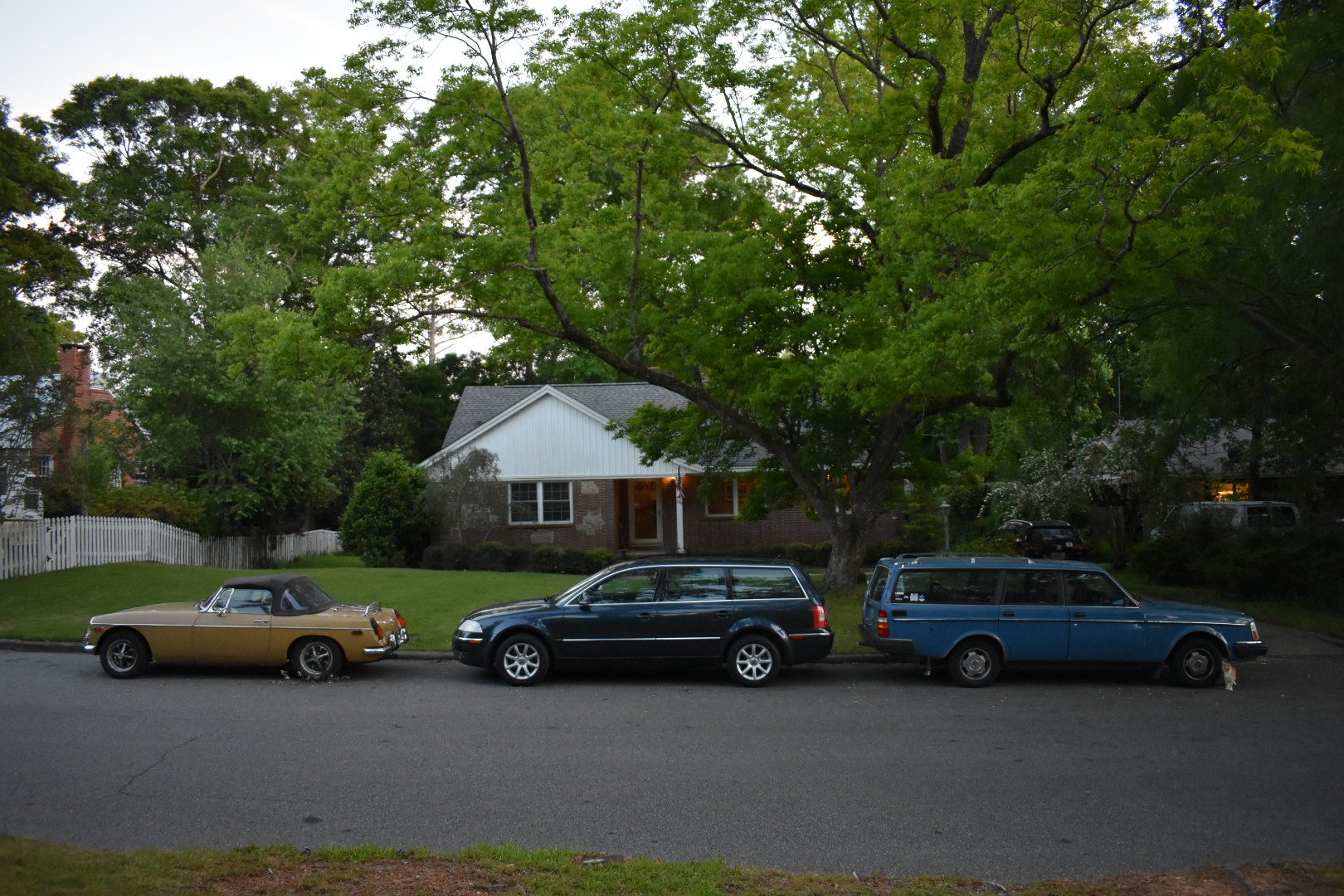
The fleet available to my brother and I at the time. From left to right:
The 1973(?) MG-B which his godmother owned since new, when it was purchased from a showroom somewhere in Monterey. It was a hoot to drive around but it was never driven enough and thus temperamental. Eventually, sometime during his time in college, it was offloaded to a friend of ours for $1000 and is still merrily driven around town.
The 2000-something VW Passat wagon. The legendary “$500 car.” It had sat for a while somewhere in West Georgia (the state), owned by our Uncle Chris’ friend. He didn’t want it. Negligible sums of money exchanged hands. It became ours. It really was a fantastic car: 4WD, grey leather interior, manual with some semblance of a clutch remaining, and quite zippy. However, it had one near-fatal flaw: It smelled like wet animal and death. No amount of damp-rid, scented vent things or airing out availed it of its signature, pervasive dank smell that came to define any amount time in it. Its time under the Georgia pines did not help.
My brother and I would take it during COVID times to Whitehall, Ohio, to be given to one of mom’s oldest friends. As a good deed. My dad was not appropriately consulted. He still mourns its loss. We promptly forgot to bring back any physical evidence that we no longer owned the vehicle. I swore we brought it back, the deed of transfer or whatever. To this day I do not know how that happened. It may be involved in crime. It may be sitting in a chop yard. No idea.
Lastly is Stu 1, the Volvo that started it all. The one that opened the floodgates to all these damn cars. 1985 245 DL with the B230. A great example we got for $1800 that I promptly ruined.
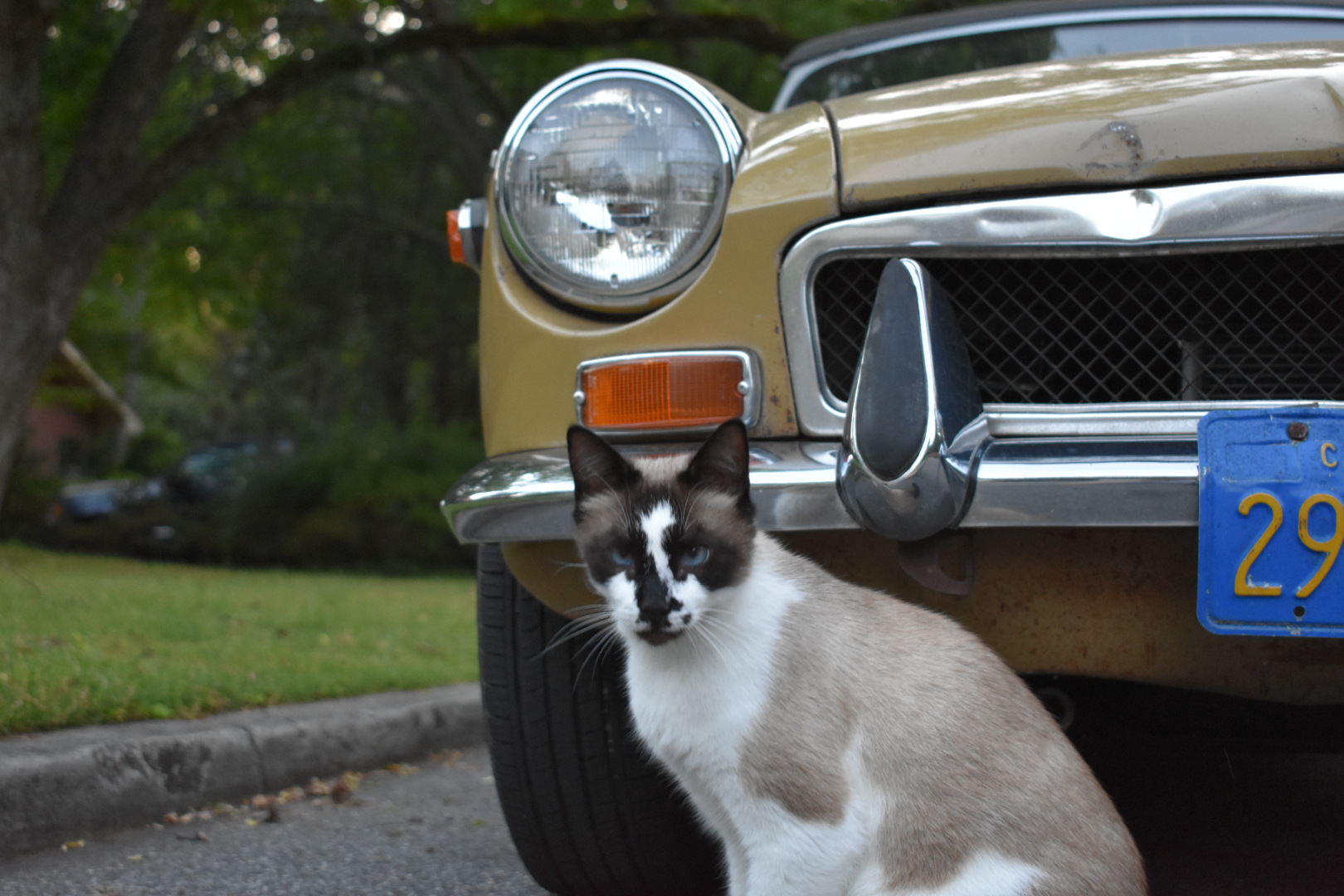
Omar, named for Omar Bradley, at the base of the MG. He was a good cat. Like many of our animals, he just disappeared one day. Coyote? Car? Got fed up and left? Who knows.
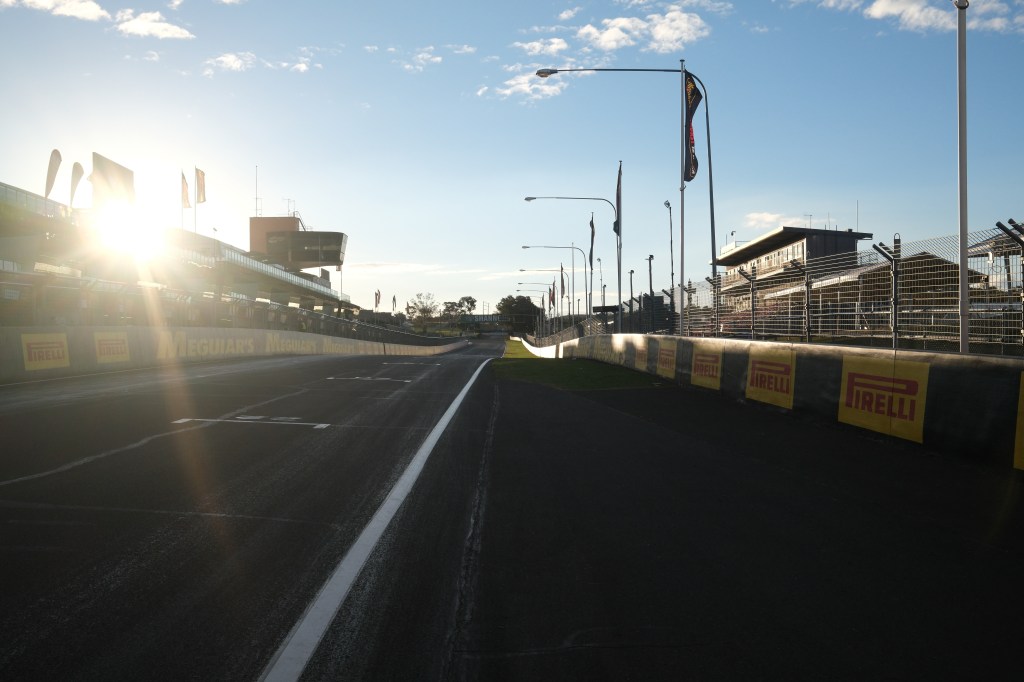
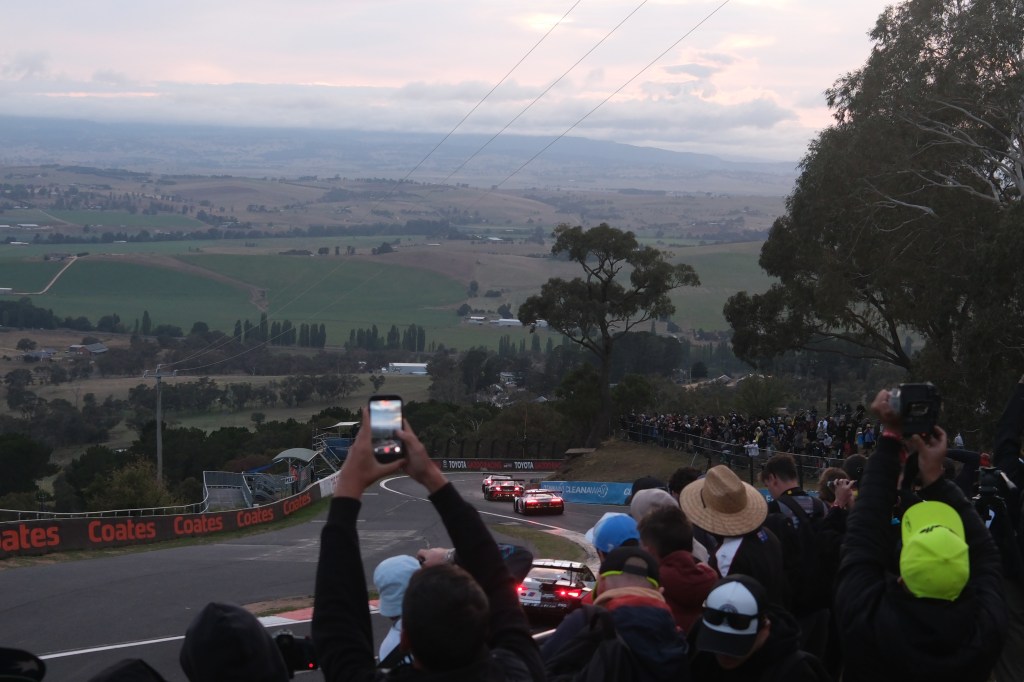
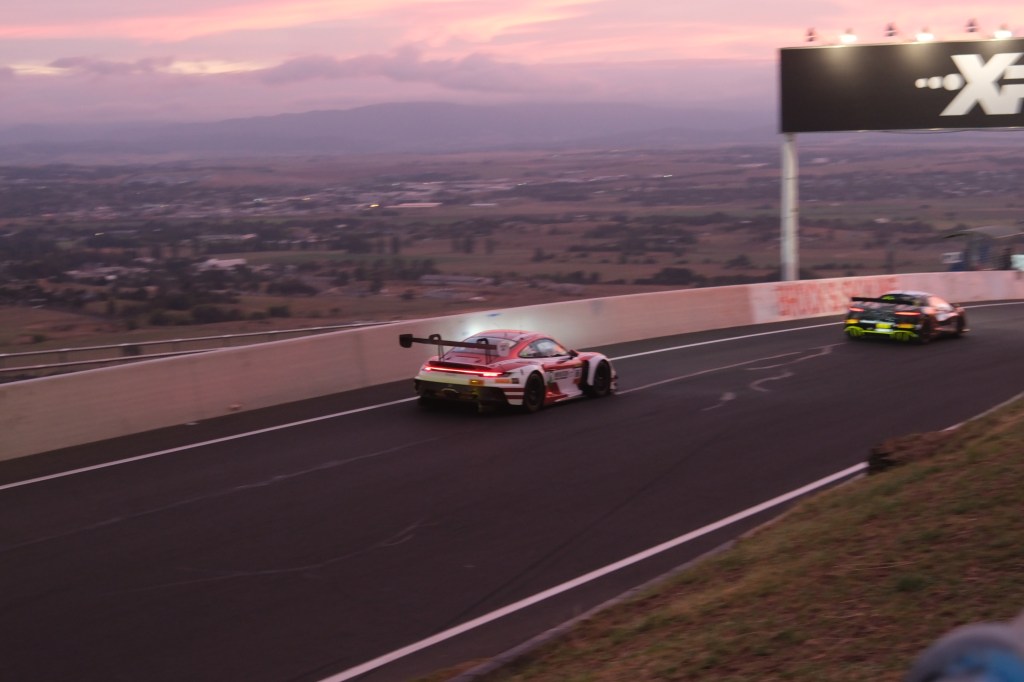
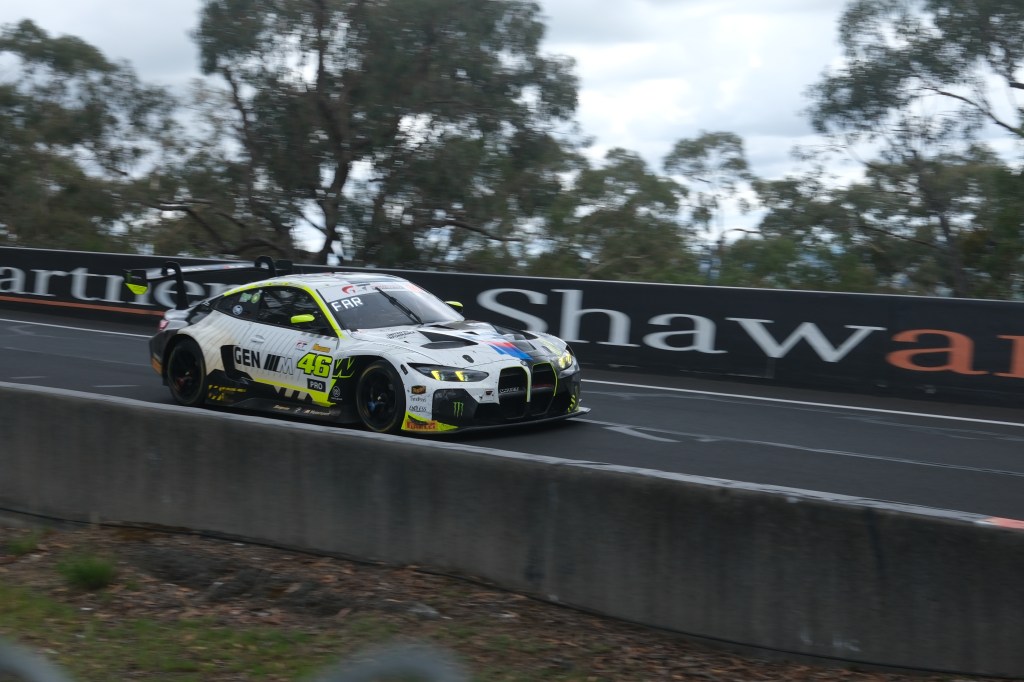
The sun sets over the main stretch of Mount Panorama Motor Racing Circuit, often simply known as “Bathurst” or “The Mountain.”
Having been to a fair few of these sports car races I believe I am equipped to make the following claims. No other sports car race on earth provides the sheer entertainment, spectator value, or intrigue as the annual Bathurst 12 Hour.
It pits a huge variety of manufacturers and car types against each other on one of the greatest and most challenging courses in the world. It attracts stars from around the motorsport world. You get great value for the the ticket. It pits Australia’s best against the world, including wildlife. You never know what will happen. It is one of a kind.
The 12 Hour is an exceptionally young event compared to the other greats in this field of motor racing. Sebring, Daytona, Road Atlanta, the Spa and Nürburgring 24 Hours, and of course, Le Mans, all boast long tenures and rich histories of anywhere from 30 to 100 years of running. The Bathurst 12 Hour only began in 1991 as a humble production car race. Its first run only lasted a short four years before being revived in 2007, and it gained new life yet again in 2011 with the admission of the popular GT3 cars to the field that, by and large, replaced most of the production vehicles.
What the race may lack in a long and fabled heritage is easily compensated by the sheer wonder of the track it is held on, the unique entries, and the incredible moments it delivers year after year.
From 2015 onwards the race benefitted greatly from new ownership in the hands of the Supercars ownership team, the introduction of the Intercontinental GT Cup and its subsequent inclusion in that Cup, the use of streaming services such as YouTube to deliver the race, and a hot streak of simply fantastic races.
Despite its short history, the race has quickly built a heritage of its own. From 2014 onwards, viewers were treated to a string of great events. Katsumasa Chiyo’s legendary charge up the mountain for Nissan in 2015. Van Gisbergen, Parente and McLaren’s record-breaking heroics in 2016. Ferrari’s iconic win in 2017 at the hands of Supercars aces Lowndes and Whincup. Audi’s triumph in 2018. Matt Campbell’s legendary last gasp lunge for the win in 2019. The thundering Bentleys running amok over the mountain for five years and finally winning in 2020.
Often, if these races did not deliver in the quality of racing, they certainly delivered in chaos. The sheer challenge of the mountain and the deviation in… quality and type of entries more often than not leads to a string of huge and bizarre incidents that variably involve poor decisions, hard racing, big shunts, and yes, even wildlife.
Day breaks over a packed esses…. everyone aiming for the same golden hour shot.
Like many things, COVID-19 almost killed the damn thing. 2021 was cancelled and 2022 and 2023 drudged along with a reduced entry list compared to prior editions. The international interest and intrigue had mostly waned, but the Australian outfits and oddball production car entries kept the flame lit, just as they had prior to the race’s growth in international stature. Only now, in 2026, do I feel the race has returned to the point it was before COVID, and this was easily demonstrated by the record 55,000+ attendance on Sunday.
It is a fantastic race. From starting in the dark to racing to the late afternoon, the setting could not be more suited to an epic sportscar race. The Mountain is the ultimate arena for these kinds of cars, a combination of elements that is described by drivers as part Nordschleife, part Macau or Monaco, and part Road Atlanta. The level of challenge it poses for drivers is only equaled by the level of beauty it provides for spectators.
The top of the Mountain is THE place to be, a place where you can get amazingly close to these cars threading the needle through the concrete canyons and Australian landscape. They always blow by with such incomprehensible speed while the elevation changes and bumps try their best to unseat the car. The cars spark and groan under the lateral loads and look completely on edge. They whistle as they approach and thunder away from you. And all of this is framed by the Australian countryside and the rolling valleys of Bathurst approximately 600 feet below your position. There is no track better, on the entire planet, to watch these machines from. Bathurst is it as far as I am concerned.
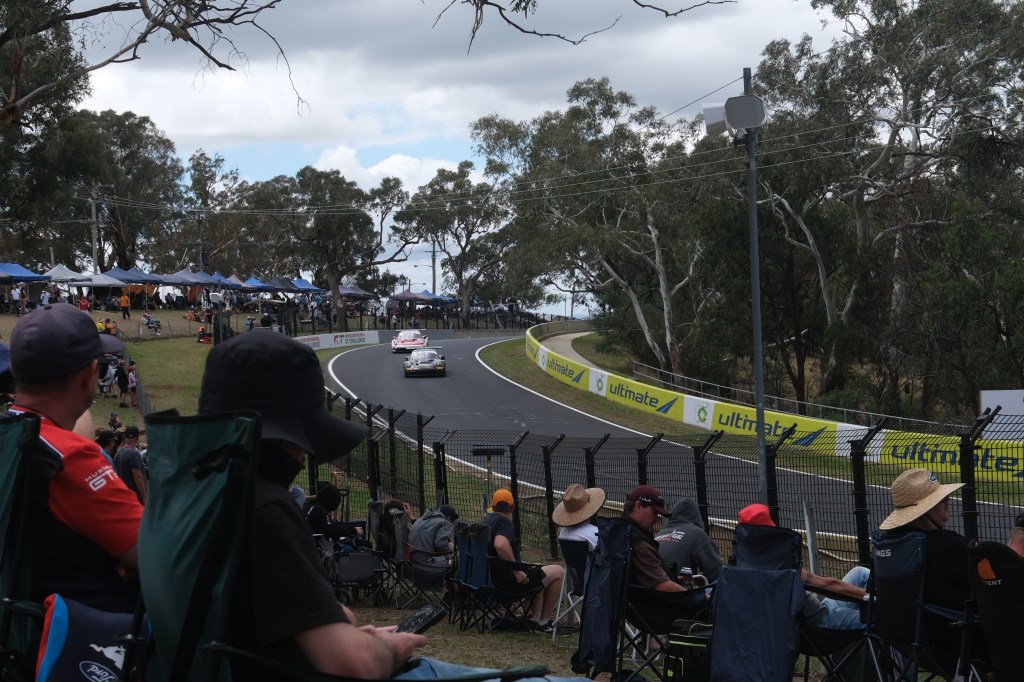
Qualifying day on the Mountain
The Race
This year delivered. Under the cover of darkness, maybe less than 15 minutes into the race, the Ford Mustang of Chris Mies turned a Kangaroo into many smaller pieces of a Kangaroo with his splitter and windshield. We were blessed with a spectacular sunset.
After the sun rose, it was a relatively un-eventful first third of the race; the WRT #46 entry (co-driven by THE Valentino Rossi) and the #32 entry comfortably led and swapped positions during pit cycles, with a few Mercedes chasing them all the while. Most notable was the #77 entry from Craft Bamboo, which sported an Initial D livery, and the two-time winner, Kenny Habul’s #75 AMG-Mercedes entry. The locally popular #222 from Scott Taylor Motorspot, an all-aussie outfit, kept within reach as did the tired old warhorse of Jamec’s Audi R8.
Around halfway, the fatigue of navigating the mountain began to set in on the drivers. Incidents began to take their toll on the field, including one I saw with my own eyes: The QUADRUPLE-penalized, moving chicane that was the sole McLaren 720S in the race eased itself into the barriers at about hour 5. The #32 fell back a ways after some damage at about this point too. My dad and I feasted on pies and fries from the stand at the Bend which benefitted the local soccer club. In my opinion, these are only concessions worth any time at the track.
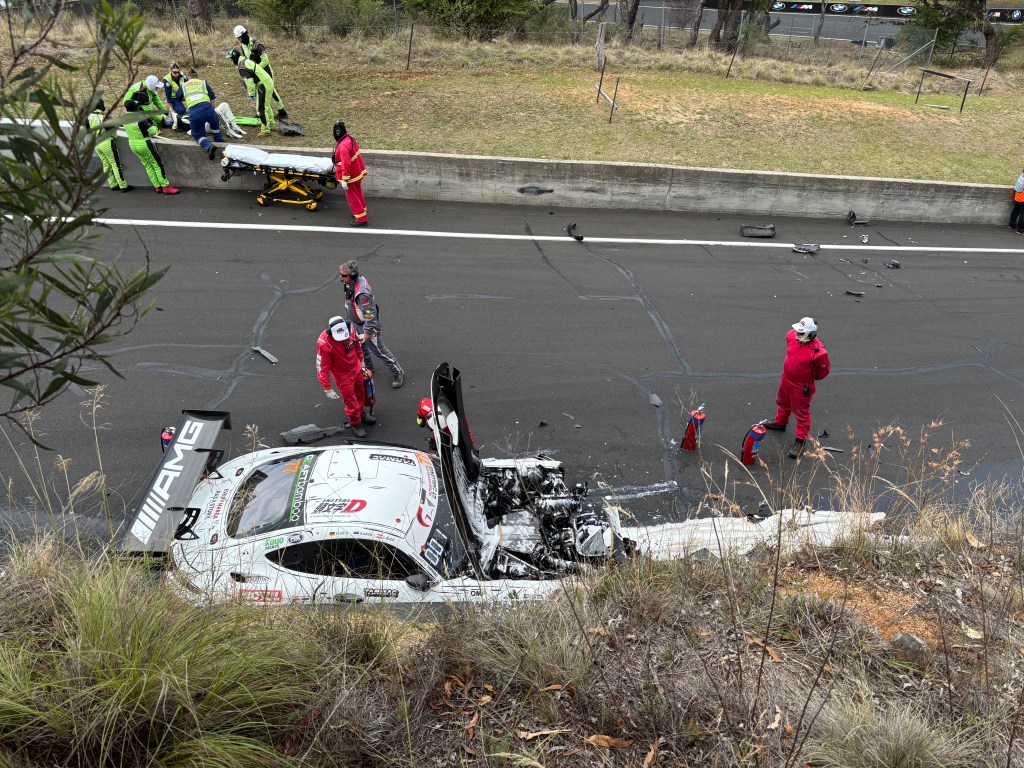
The race was completely flipped on its head when Paul Aron, finding himself in the lead for Craft Bamboo after a yellow for a reason I cannot recall and sloppy driving from the #46, plowed into a spun car at the base of the mountain due to various holes in marshalling and communications. It completely obliterated the car and will certainly go down as one of the largest incidents in Bathurst 12 Hour history. We were standing there just thirty minutes earlier. I walked down to take in the carnage, and what a sight it was. Immediate red flag.
The destroyed #77, still bearing the marks of its short time in the lead, now ruined. Paul Aron lies on the grass at rear.
The #75 now looked to be set for its third victory in four years, having inherited the lead. The #888, having come from 29th on the grid also appeared in 2nd after the red flag. But then came the chaos. First, the #2 Corvette, having shown surprising pace all day, lost its bid for a win at the base of the Esses due to suspension failure. It appeared now that the #75 and #888 could just cruise to a 1-2 for Mercedes. But it was not to be.
A pair of Aussie-fielded Mercedes got together coming up the mountain, in a display that sort of indicates the Supercars guy’s apparent inability to follow through on longer stints, and brought out a yellow. While the rest of the field pitted, the #32, having crawled back from its wildlife-induced damage, sat in the lead on the final restart. And then quickly squandered this by throwing the sloppiest block into T1 on the restart and getting plowed by the #75. We had migrated down to T1 specifically for this restart and it ended up being the deciding moment in the race. The #888, #46, and the sneaky Pro-Am Porsche 911 (#86) snuck through and finished in that order.
Post Race
After the race we got to run straight to the podium. Saw Vale46 in the flesh. Observed the teams packing up. Went for a run of the course. And found Kangaroo bits on the backstretch. The area still reeked of livestock, animal, and motor oil. I picked up a small piece of Ford-blue carbon, splattered with Kangaroo blood. I will leave the pictures out of this one.
June 11th, 2026 (important detail): I texted Javi as I began boarding my flight to “San Salvador” International Airport from Atlanta’s austere Terminal F.
“??” was the reply. His gig down there was July 8th to 13th not June. I insist that I’m innocent.
In a panic, I booked a “Surf Villa” in nearby La Libertad during the taxi and off we went. Too much effort to change any flights and not take the trip. Pretty much everything that follows is a dumping ground for my thoughts on the past two days…
Transportation
South America is largely moved by the deep and throaty lope of heavy diesel engines, just as much of Europe trundles along to the rhythmic clicking of TDI valves. The highways or major roads are totally enveloped by the unmistakable roar and signature black clouds of smoke as buses lumber away from totally unmarked but locally known stops.
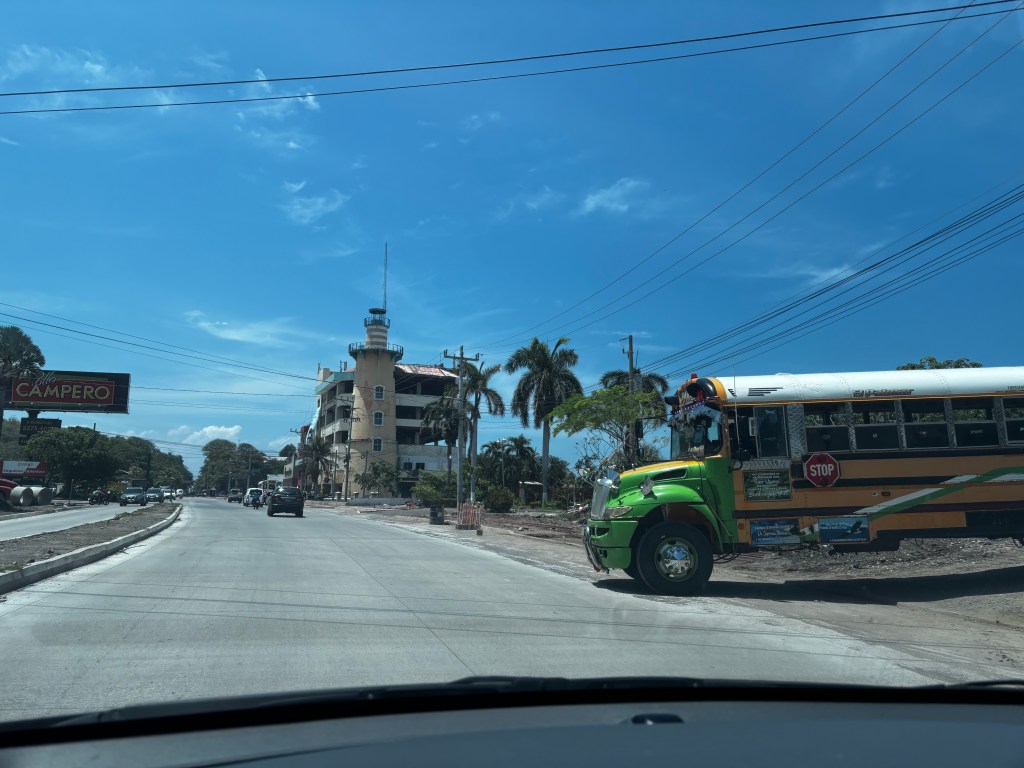
El Salvador is another entry into the book of Absolutely Fascinating and Terrifying South American Bus Systems. The busses here are predominantly imported American school bus models that we all know, mostly the 40+ seat Trane or Bluebird models. I swore I saw one with the vague remnants of “New Britain Sch-” on its side. They are brightly decorated with green, blue, purple, or reddish-orange hues, though some maintain their stock yellow, with each color scheme ostensibly identifying a route. But there was no obvious standardization or governing body. Some sport fiberglass wings at the rear, some wear chrome. All have an interesting squat at the rear end, perhaps intentional, or a sign of well-worn leaf springs. While much larger than their Chilean equivalents, these landships are driven with the exact same fervor, although they are evidently limited in their traffic-cutting abilities by their sheer size and weight. My favorite was the 102 bus from La Libertad to San Salvador (I think) in a nice deep green, white and yellow-sh scheme. Fifty-nine cent fare.
oops probably the best pic I got. not the 102. Maybe 187.
San Salvador
I needed to see the big city. The library in San Salvador was explicitly mentioned by the rental car counter folks as something to see and do in the city, so I went there first after parking.
It is an interesting study in dueling hegemons or perhaps a case study of where Latin America finds itself in the global order. It is a very new building, opened in 2023 with striking architecture that sets it apart from literally everything else in the country. It is immediately adjacent to the national palace, on the site of the former national library. It is evident that great effort has recently turned the area in front of it into a large pedestrian plaza, something akin to a national gathering place. It would not be out of place in the urban centers of Shanghai or Shenzhen.
Most interestingly, the library proudly sports, over its entire edifice, a red badge proclaiming: “ASISTENCIA DE CHINA: PARA UN FUTURO COMPARTDIO.” This is about as subtle as a wrought iron gardening tool swung against the side of your head. China devoted $54 million dollars through its aid group towards building this highly modern, 24/7 library. Yet, the library itself is filled to the brim with curious displays of American culture. Star Wars, Game of Thrones, Lord of the Rings, and various superheroes fill the lobby and aisles. American computers are draped on nearly every floor. Just outside the library, you will find a Marriot, a Pizza Hut, a Burger King. And in each of these establishments, American dollars pass over the counters.
The Market
As soon as I set foot into the open air market, set just off the main market building itself, a chorus of “Una dollar, una dollar!” welled up, overtook the square, and did not stop until I left. I hadn’t meant to end up here, but I was glad I did. It feels super lame to type this out but the sheer variety and density of noise, the busyness of the square itself, the variety of goods offered, it was like something and somewhere I’d never been before. And it was not for show. People did their daily shopping here and made a living, or tried to. A complete sensory overload. But there’s no way everything was a dollar.
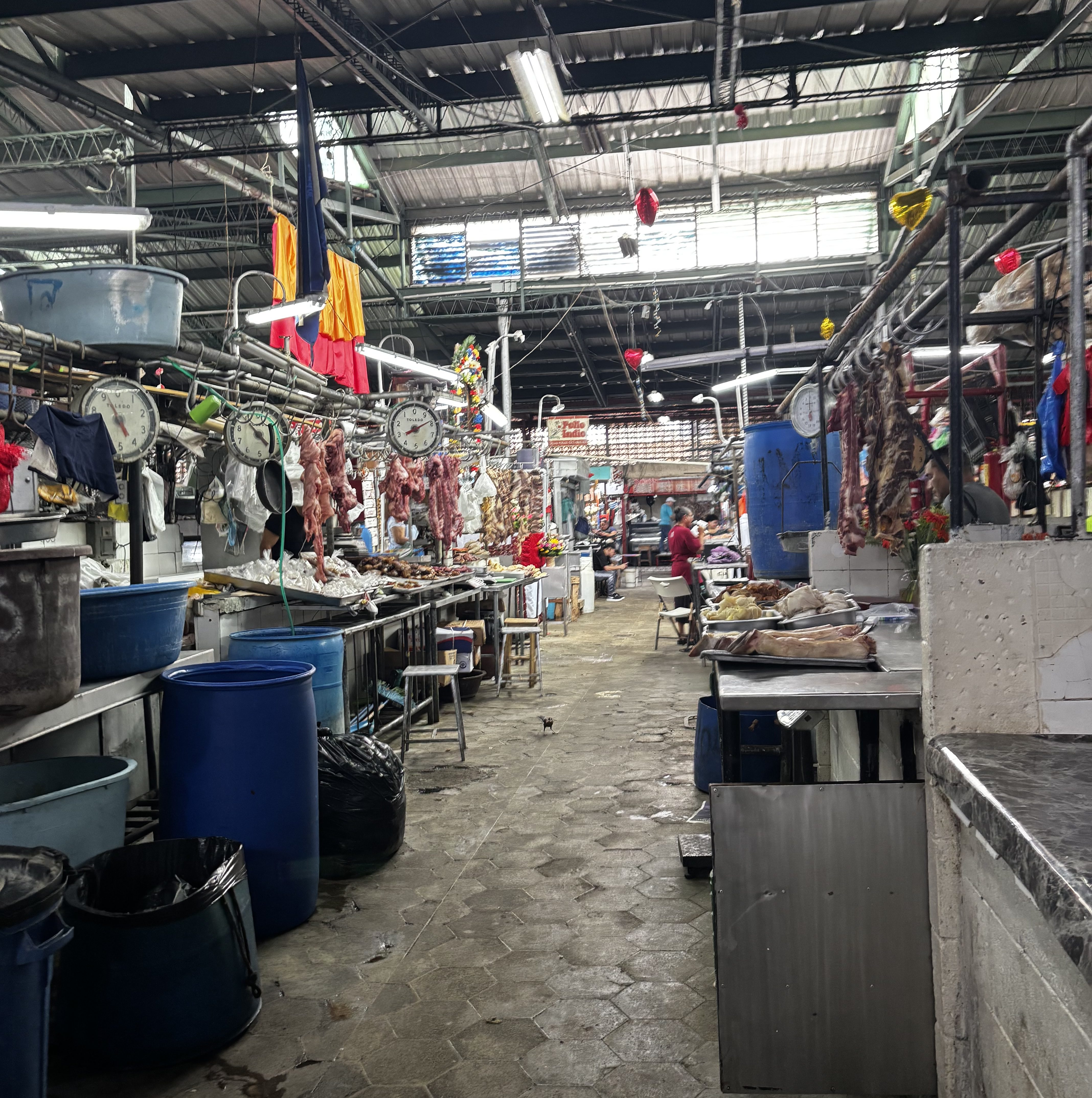
View into the meat section of the market. Hordes of women were stuffing small sausage casings and tying them off all in one fluid motion. I wanted to just stop and watch but it felt weird honestly.
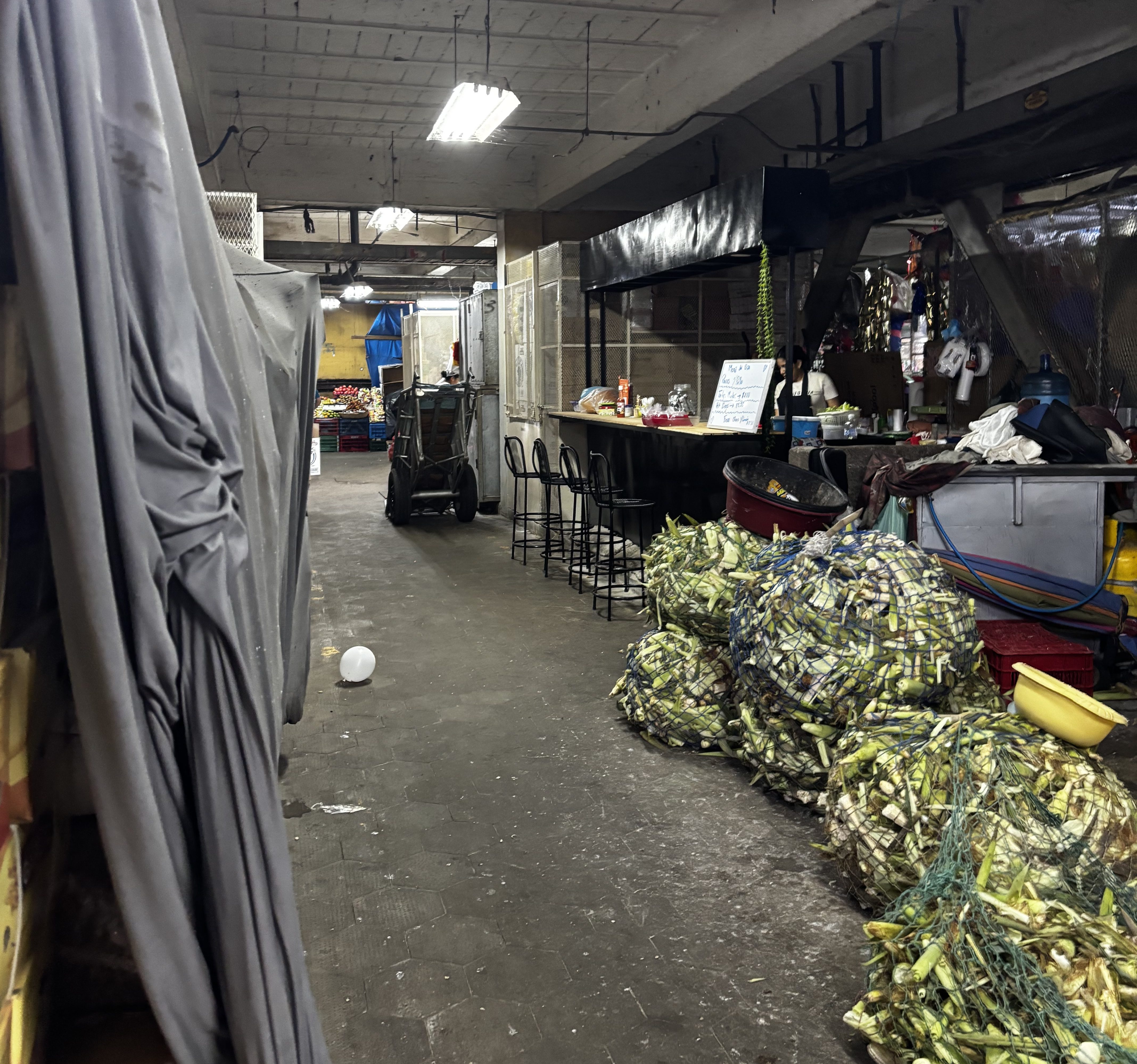
I dipped back into the main market, which was an absolute labyrinthian system that I can only assume was split into an upper and lower level. Organization by type of good was evident but I completely failed to grasp how it was all arranged. Live animals, produce, meats, household goods, food, beer, religion, music; all of it was here and all of it for sale. I was completely overwhelmed and, exasperated, settled on the first place with a menu so I knew what I was getting and how much it cost. It was a nameless stall deep in the basement of the market run by a mother and daughter duo, next to the largest pile of garlic I’d ever seen and kids husking sweet corn while ripping TikTok dances. Globalization.
I fumble-fucked my way through a horrendous conversation (Pollo? I pointed at the stove desperately hoping for the chicken soup… oh she’s saying something… not ready for… thirteen? minutes? fuck. Torta Mixta. crap I don’t know what she’s asking. Si. whatever, this will be good.) Ended up with some sort of sandwhich, which was good, comprised of gamey beef, hot dog, lettuce, tomato. And aguas frescas. $2.30. I also got some sort of sopa de pollo from a vendor promising it for just “una dollar” but paid $7 and it honestly wasn’t much to write home about.
Lunch spot. Deep in the basement
Back at the Beach
Retreated to my Surf Villa after the day in San Salvador. I ended the day up in San Salvador in one of the richer neighborhoods up the mountain (New Jerusalem?) and had some bomb ass coffee.
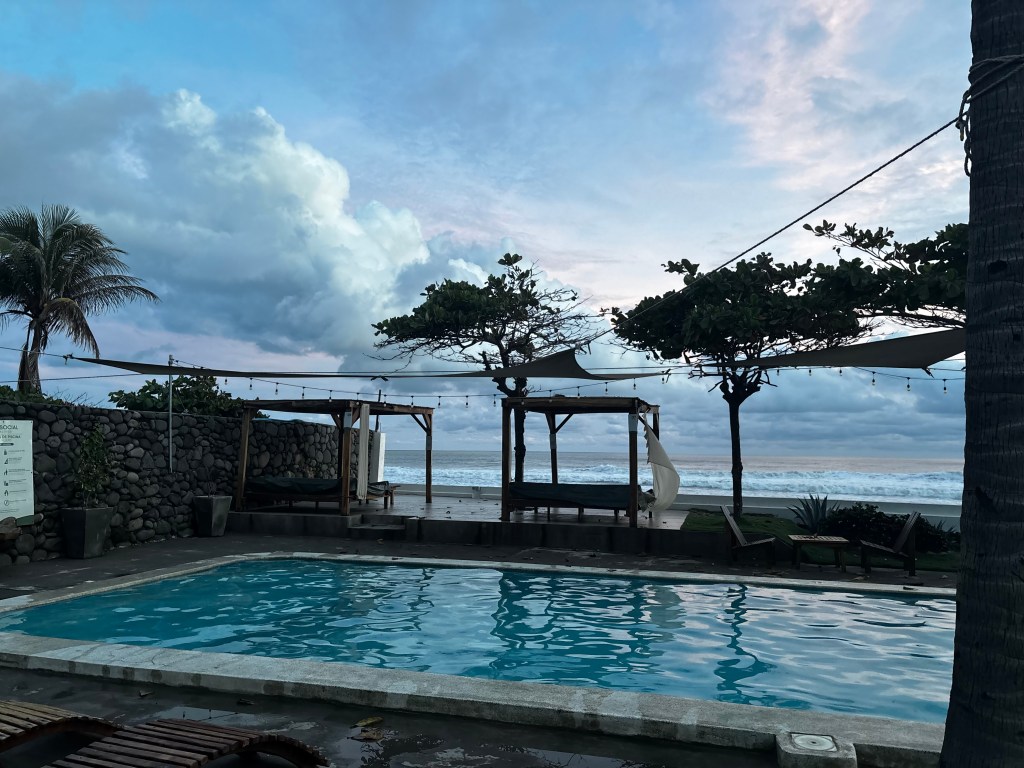
Ended the day at a “beach bar” which I think is genuinely just someone’s home that’s conveniently adjacent to the Villas, and had four beers for $6. I watched the waves crash up on the scraggly stone beach and generally had a blast just chilling there. What a time. Ace Pilsner. La cerveza de El Salvador.
Got some pupusas at the place down the street for, of course, a dollar each, and that was my night. Kinda sick.
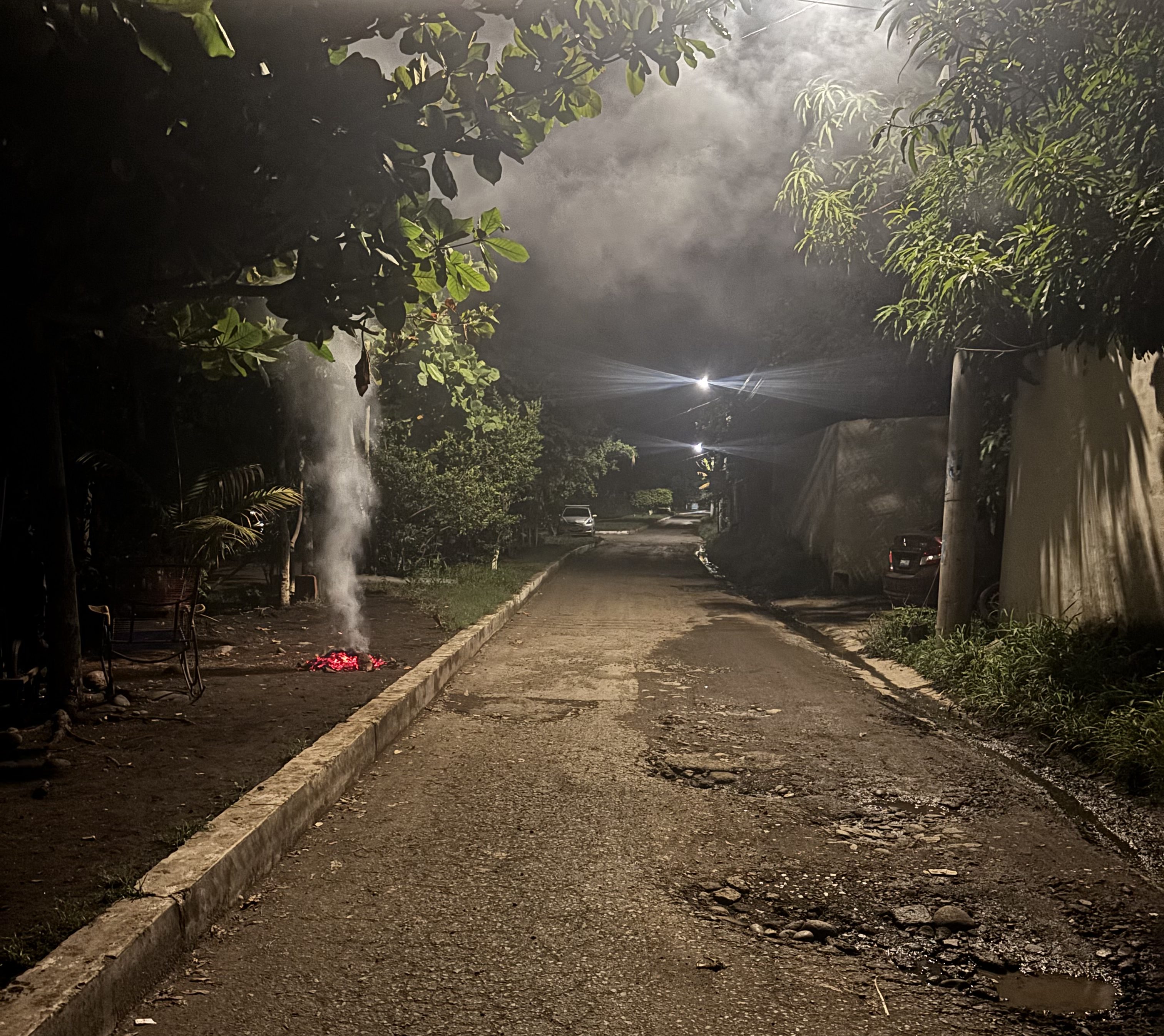
Coconut husks burn in a pile after the day’s end. Pretty certain the coals from these would become the basis of the next day’s cooking fire.
Anyways, check your dates before you schedule these things.
but you cant stay here because we gotta switch to the breakfast menu and, it, its gonna take like, 15 minutes for the system to sw- yes yea it does take that long – no, ok. y-yea the cars in front of you already had their order taken so I would just back out if I we- ok goodbye
Roommate has food poisoning. Thus, freed from a 9:30AM quest to LAX. Brakeless Kilo TT to the Navy Gym. Cutting thru traffic on 2nd Street like I’m #MASH #messenger #fixiefoo #2009. Just missing a Chrome bag and U-Lock and swag and pretty much everything else except for the bike.
Nothing earth shattering to share today except for the fact that I’m here. Doused half a bottle of bargain TJ’s screw-top Perrin CdP blend and half a fondue pot. So here I am.
Blurry pic of rich guy as Jackie Stewart in his Tyrrell @ 2023 LBGP fo today. Finally emptied some old SD cards onto the tortured, malingering, cadet laptop.
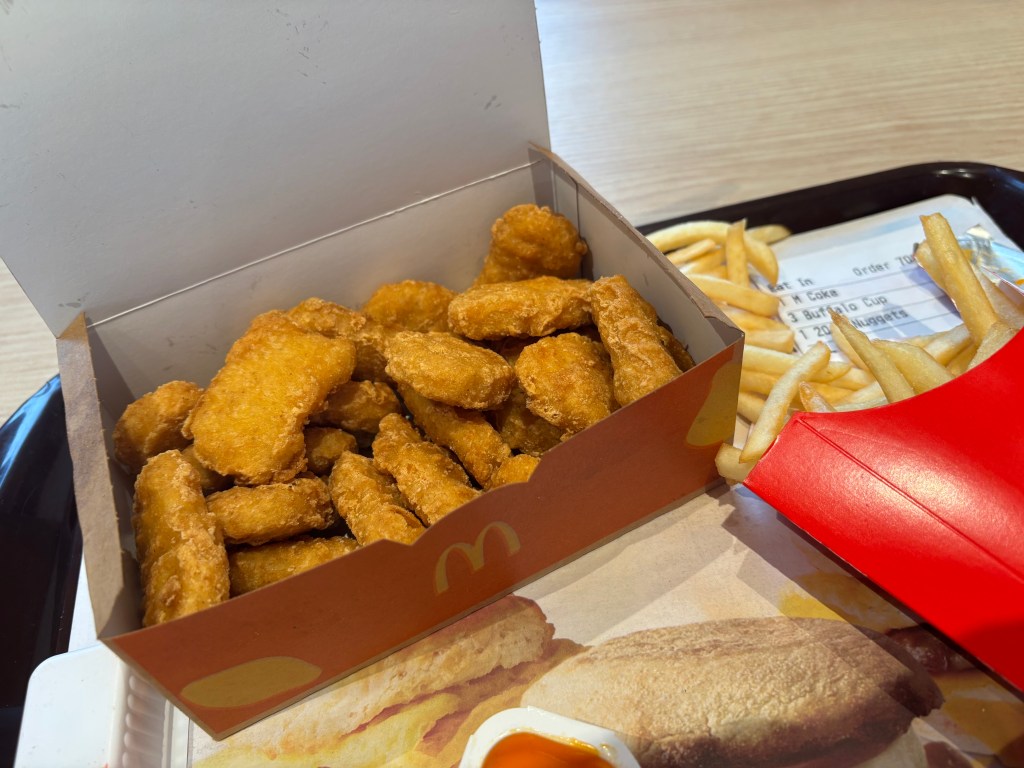
Stopped at the McDoinks off US HWY 80 in Montgomery, AL, just east of the bustling aerodrome that is the Montgomery Regional Airport (MGM). Passed a few gutted hotels with interesting new branding and tenants and tucked in to some McNugs.
Check this out. Way more than 20 pieces. Fatass status achieved. Pairs well with their nuclear orange buffalo sauce that has a vague Elmer’s Glue scent and texture. And I was on my way. The entrance to AL HWY 331 southbound is truly one of the nation’s finest examples of breathtakingly depressing sprawl.